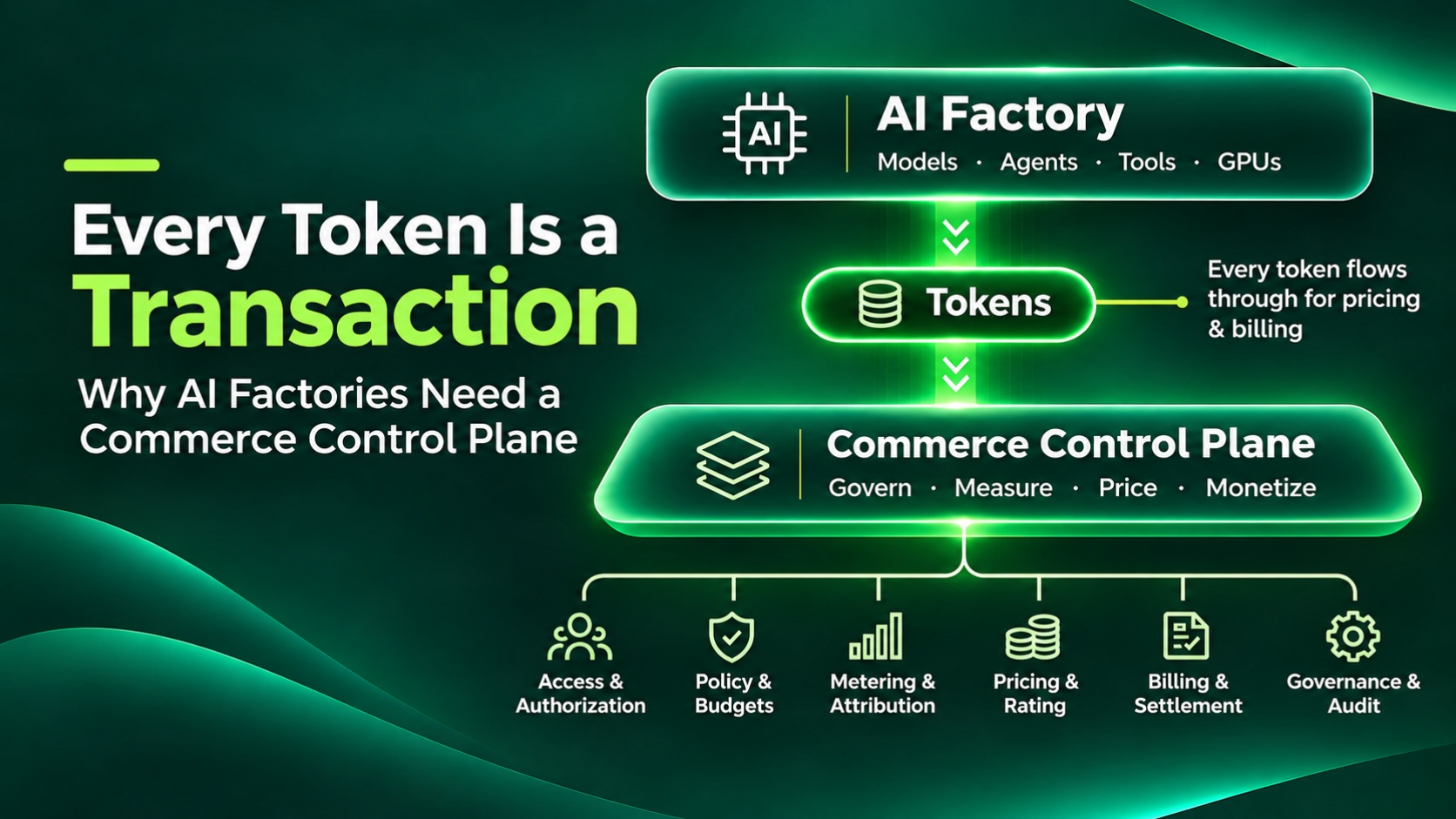
Picture an ordinary Tuesday at an AI company.
A customer burns through its prepaid credits before lunch. GPU costs shift twice as workloads move between clusters. A model provider and a reseller both earn a share of the same transaction. An AI agent resolves a case, but the fee depends on whether the case stays closed.
The quote-to-cash system will tell finance about all of it next month, in a report.
By then, the company has already decided whether to run thousands of additional requests, which models to route them to, and how much credit to extend. Every one of those decisions depended on economics the business could have known sooner.
Quote-to-cash for the AI era needs a ledger framework that records the economics as work happens and settles with customers and partners on the terms they agreed to.
The world the revenue ledger was built for
Seat-based software had a predictable economic shape. A contract specified how many seats the customer bought and what they cost. Billing could generate the invoice in advance, the ERP could book it, and finance could work out margins, commissions, and partner shares after the fact.
That model worked because relatively few decisions depended on knowing the cost of serving a customer right now.
An AI request changes that. Its cost can vary with the model, provider, region, compute rate, and cache usage. The customer might pay by token, draw down a prepaid commitment, or owe a fee only after a verified outcome. The same request can be profitable on one route and lose money on another.
Once those differences affect the next operating decision, finance needs more than a revenue ledger.
One economic event can affect several ledgers
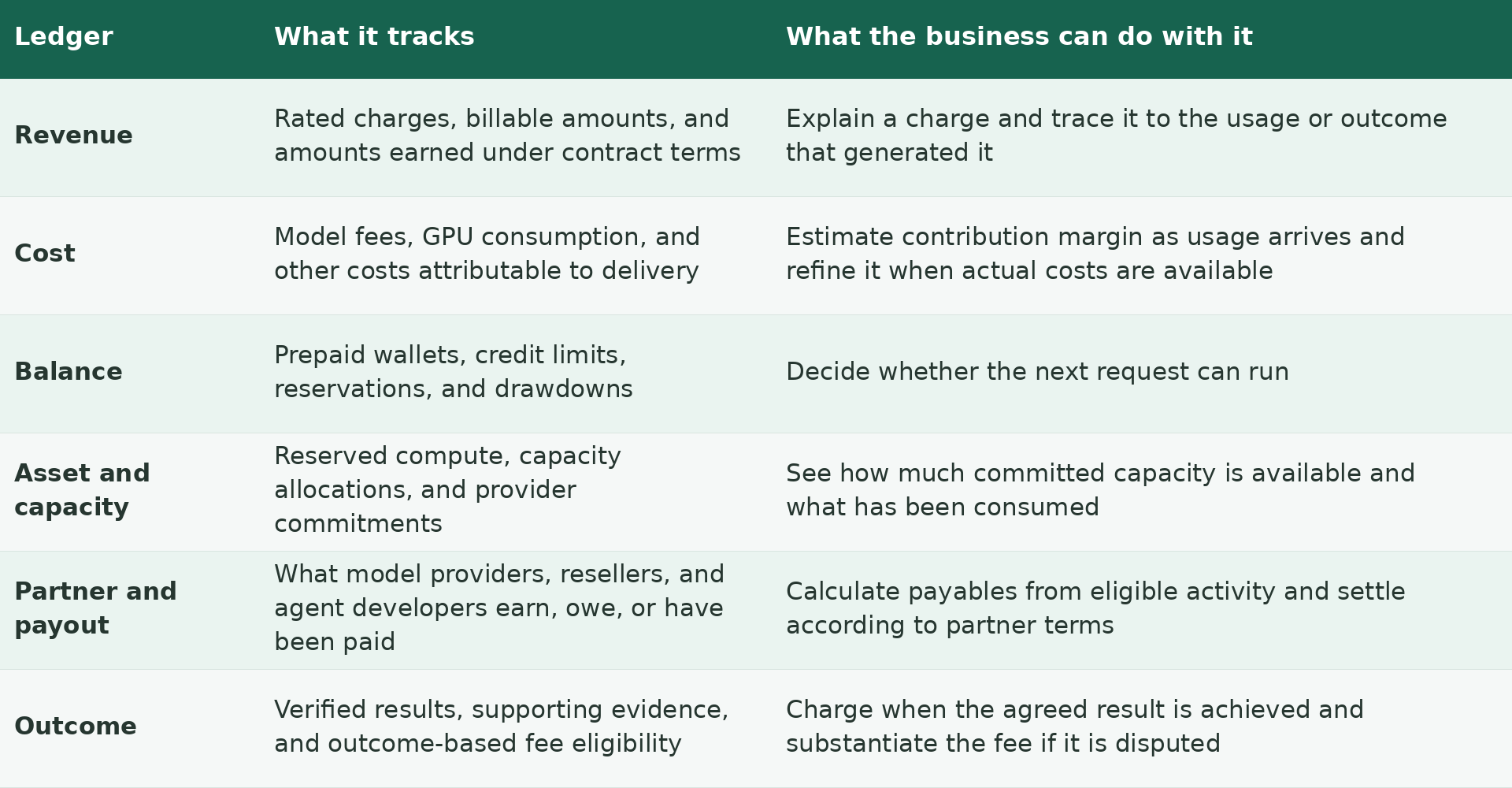
These ledgers draw on the same underlying events and use the same contract references. Each posts when its rules are met. A request can consume credits and incur cost immediately. A provider can confirm the actual cost later. An outcome fee can wait until there’s evidence that the customer got the result they agreed to pay for.

What happens when a customer has five cents left?
Say a prepaid customer submits a request that ultimately costs them $0.05. Before the request runs, the platform reserves the available credit so a concurrent request cannot spend it too. After usage is measured and priced, the platform converts the reservation into a drawdown.
The same transaction records $0.02 in attributable delivery cost and accrues $0.01 owed to the reseller, leaving $0.02 in contribution before other costs. When the next request arrives, the platform can see that the available balance is zero and enforce the customer’s prepaid terms. The reseller’s penny can be included in its next scheduled payout, with a link back to the usage that earned it.
Finance can follow the transaction from the customer’s quote and contract to the wallet drawdown, the cost, and the partner payable. Operations can use the updated balance before sending the next request to a GPU.

Uber can pay after every trip. When do you know what your AI partners earned?
Drivers who activate automatic payouts to the Uber Pro Card can receive their earnings after each completed trip. Uber can offer that option because it can determine how much is available to pay out at the trip level. If a fare changes later, the platform can account for the adjustment. Uber Help
AI infrastructure providers face a similar operating question. A GPU provider delivers capacity, a model provider serves inference, and a reseller brings the customer. Each may earn something from the same transaction, under a different agreement.
Knowing what each partner has earned and deciding when to pay them are two separate decisions. A partner can see eligible earnings accrue per request and receive cash daily, weekly, or on another negotiated schedule. If a payout is disputed, both sides can trace it to the usage and terms behind it.
Reports can explain what happened. Ledgers give you something to act on.
A warehouse report can tell you a prepaid customer overspent yesterday. At request time, the gateway needs an authoritative balance and a way to reserve it. A margin dashboard can show that a model became more expensive over the weekend. A team making routing or pricing decisions needs to know which workloads are affected while they are still running.
The same problem shows up at close. If billing, finance, and partnerships each reconstruct the economics independently, a new pricing rule can yield three different answers. Finance then has to reconcile the invoice, the cost, and the payout without a shared transaction record.
Reports are valuable for analysis. The ledger framework supplies the underlying records that make the reports actionable and reconcilable.
What a quote-to-cash ledger framework needs
- One record of each economic event. Capture accepted quotes, metered usage, wallet top-ups, verified outcomes, and payments as durable events. Apply versioned posting rules so a retry cannot charge the customer twice and finance can reconstruct the original calculation.
- A trace from quote to cash. Link each entry to the contract, applicable rate or rule, and source event. Follow a charge through the invoice or wallet drawdown and, where applicable, to the partner payout.
- Live balances and enforceable limits. Reserve credits before serving a request, apply the final charge once usage is measured, and release any unused reservation. Use the same balance to enforce the customer’s limits.
- Configurable meters, pricing, and partner terms. Define tokens, GPU-hours, credits, and verified outcomes as commercial units. Configure how they are measured, priced, and shared so each new offer can use the same posting and reconciliation process.
- Controls built into every posting. Preserve original entries and record corrections through reversals or adjustments. Identify the system, person, or agent behind each action, and reconcile the operational ledgers to their sources and the ERP.
The ERP remains the accounting system of record for the general ledger and statutory close. The ledger framework is the operational system of record for the economics that happen between the quote and the cash.
Five questions for your quote-to-cash platform
- What did a single AI request cost us, and what contribution did it make?
- Can we enforce a prepaid limit before the next request runs, even when several requests arrive together?
- Can we settle partners on their agreed schedule and tie every payout back to the usage or outcome that earned it?
- Can we launch a new meter, pricing model, or partner program using the same posting and reconciliation process?
- Can finance trace a charge, cost, wallet movement, or payout back to its contract, source event, and applied rule?
The month-end close still matters. So does the moment a wallet runs out, an inference route becomes unprofitable, or a partner earns its share. The companies that can see those events as they happen can act while the decision still matters.
At Monetize360, we’re building this ledger framework into quote-to-cash so AI businesses can authorize the next request, understand what they earned, and settle with customers and partners on the terms they agreed to.