


Every AI factory is, at its core, a factory for tokens.
Behind every token is a chain of infrastructure: GPUs, models, inference engines, orchestration platforms, AI gateways, and data pipelines. Together, they turn compute capacity into intelligence.
But there is a fundamental gap in how we operate and monetize these factories.
The token is often treated as a technical by-product of inference rather than what it really is: a commercial event with an owner, a price, a budget, and a counterparty.
Who authorized its consumption? Which customer, application, agent, or business unit owns it? What did it cost to generate? What should it be priced at? Who is accountable for the spend? And ultimately, who gets paid?
These are not simply billing questions. They are questions about control, accountability, and trust.
As AI factories evolve from infrastructure platforms into businesses delivering intelligence as a service, they need a new architectural layer: the Commerce Control Plane.
1. Tokens are the new unit of commerce
The economics of AI are fundamentally different from traditional infrastructure.
In conventional cloud environments, customers often buy servers, storage, or compute capacity. In AI environments, the value increasingly moves toward the consumption of intelligence: tokens generated, models invoked, agents executed, tools called, and outcomes delivered.
A single enterprise AI request may involve multiple models, several agents, external tools, GPU resources, and multiple service providers. Each interaction can create a cost, consume an entitlement, and contribute to a customer-facing charge.
Consider an enterprise deploying an AI-powered customer service agent.
One customer interaction may trigger:
- An input token charge for the language model.
- An output token charge for the response.
- Embedding and retrieval operations.
- Tool calls to CRM, billing, or other enterprise systems.
- GPU and inference infrastructure consumption.
- Multiple agent-to-agent interactions.
The business may see one completed customer interaction. The infrastructure may see hundreds of individual events.
Without a way to connect these events to commercial intent, operators can measure utilization but struggle to understand the economics of the service.
The unit of AI commerce is no longer just compute capacity. It is the consumption of intelligence, and increasingly, the value delivered by that intelligence.
2. Two stacks that never meet
Today, most AI factories are built around two largely separate stacks.
The technical stack manages the production and delivery of intelligence:
- GPU infrastructure and accelerators.
- AI infrastructure orchestration.
- Model serving and inference engines.
- AI gateways and routing.
- Agent frameworks and execution environments.
- Telemetry, performance, and observability.
The commercial stack manages the business of delivering that intelligence:
- Customer identity and contracts.
- Product catalogs and service plans.
- Entitlements, quotas, and budgets.
- Usage measurement and attribution.
- Rating, pricing, and discounting.
- Billing, invoicing, revenue assurance, and settlement.
- Partner and infrastructure-provider economics.
Both stacks are essential. But they frequently operate independently.
The technical stack knows what happened. The commercial stack knows what was agreed.
The missing connection is the ability to translate commercial intent into runtime controls, and translate runtime activity into trusted financial evidence.
This gap becomes increasingly significant as AI services become multi-tenant, multi-model, agentic, and consumption-based.
An AI factory may know that a GPU generated 10 million tokens. But can it determine which customer consumed them, whether that customer was entitled to the service, which contract governed the usage, what price applied, and whether the resulting charge is financially defensible?
That is the problem the Commerce Control Plane is designed to solve.
3. The missing layer: a Commerce Control Plane
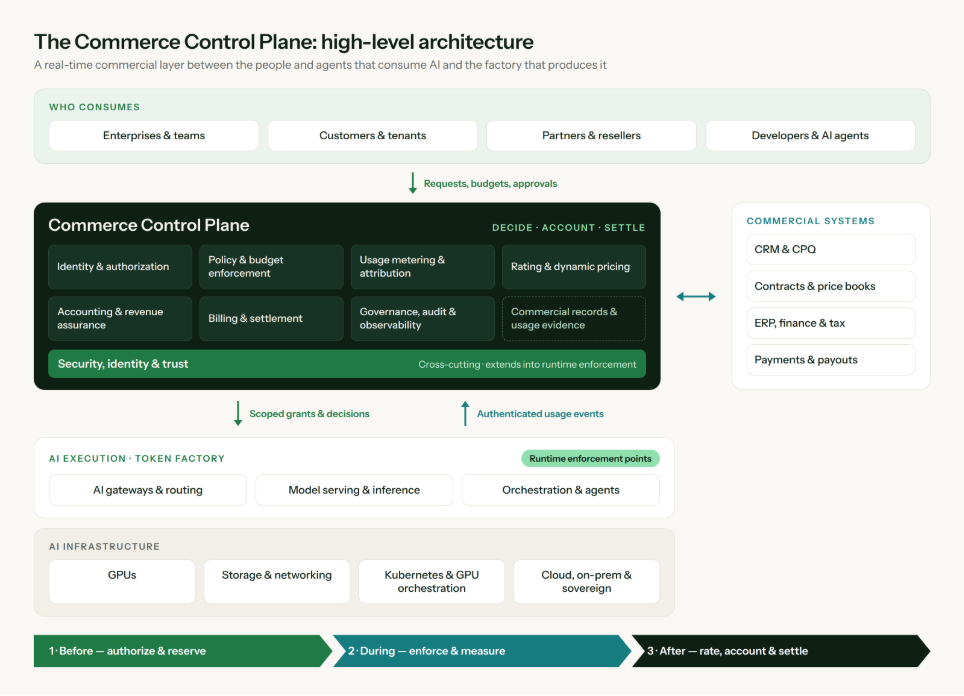
A Commerce Control Plane connects the commercial and technical worlds.
It is not another AI gateway, inference engine, GPU orchestrator, or billing application. It complements these systems by providing the commercial intelligence and control framework that governs consumption across them.
Its responsibility is to make every AI consumption event commercially governed, attributable, measurable, and monetizable.
The Commerce Control Plane brings together seven core capabilities:
- Identity and authorization: Establish who or what is consuming the service, on whose behalf, and under which commercial relationship.
- Policy and budget enforcement: Apply entitlements, quotas, spending limits, approval rules, and consumption policies.
- Usage metering and attribution: Capture and associate tokens, model calls, agent executions, tool calls, GPU usage, and other billable events with the right customer and business context.
- Intelligent rating and dynamic pricing: Apply contract terms, service plans, usage tiers, market benchmarks, model economics, and pricing strategies.
- Financial accounting and revenue assurance: Validate usage, reconcile events, detect anomalies, and establish accurate financial records.
- Monetization, billing, and settlement: Generate charges, manage wallets and credits, invoice customers, and settle with infrastructure and ecosystem partners.
- Governance, audit, and observability: Provide a traceable view of commercial decisions, consumption, financial outcomes, and policy compliance.
Together, these capabilities establish a commercial control framework for AI services.
4. Commerce before, during, and after every request
The Commerce Control Plane must operate across the lifecycle of an AI request, not just after usage has occurred.
Before consumption: establish the right to consume
Before an AI request is executed, the system needs to establish:
- Who is making the request?
- Which tenant, customer, application, or agent owns it?
- Which contract, subscription, or service plan applies?
- Is the requested model or service permitted?
- Does the consumer have sufficient budget, credits, or entitlement?
- Are there applicable rate limits, approval requirements, or policy restrictions?
Based on these decisions, the request can be allowed, denied, throttled, redirected, or routed for approval.
During consumption: govern and measure execution
As the request moves through the AI infrastructure, the system needs to:
- Enforce approved policies and consumption limits.
- Meter input and output tokens, model calls, agent executions, and tool usage.
- Attribute consumption to the right customer, application, department, or business outcome.
- Track usage against budgets and entitlements.
- Detect abnormal consumption patterns and potential misuse.
The goal is to make consumption visible and governed while preserving the performance of the inference path.
After consumption: establish the financial truth
Once execution is complete, the system needs to:
- Validate and reconcile usage events.
- Deduplicate and identify missing or anomalous records.
- Apply the correct pricing and contract rules.
- Calculate customer charges and provider costs.
- Update wallets, credits, and financial balances.
- Generate invoices and revenue records.
- Calculate partner shares and settle with providers.
This creates a continuous commercial lifecycle around every AI request.
The guiding principles are simple:
Decide centrally. Enforce locally.
Reserve first. Settle on actuals.
Treat usage events as financial evidence.
An important distinction matters here: an authorization decision is not proof of consumption. A request may be approved but never executed, or execution may produce a different amount of usage than initially estimated. Financial settlement must therefore rely on independently validated usage evidence.
5. Trust is the foundation, not a feature
A Commerce Control Plane cannot be effective without security and trust built into its architecture.
AI factories introduce new dimensions of risk. Consumption can originate from people, applications, autonomous agents, or other agents. Requests may cross organizational boundaries, model providers, infrastructure platforms, and geographic jurisdictions.
The system must establish more than authentication. It must ensure that every action is authorized, every event is attributable, and every financial outcome is auditable.
That requires:
- Strong identity and authentication for users, applications, services, and agents.
- Fine-grained, policy-based authorization across tenants and resources.
- Short-lived, scoped permissions and secure delegation.
- Tenant isolation and protection of customer data.
- Integrity and traceability of usage and financial events.
- Tamper-evident audit trails and separation of duties.
- Threat detection, anomaly monitoring, and resilient operations.
- Explicit fail-open or fail-closed behavior based on the risk of the service.
Security must also be implemented without introducing unnecessary latency into inference.
A practical architecture makes commercial decisions centrally but enforces approved policies close to the gateway or execution environment. Short-lived authorization grants and locally enforceable policy controls can help avoid a centralized round trip for every generated token.
The principle is straightforward:
Every token requires authorization. Every consumption has accountability. Every financial outcome has evidence.
Trust is not an optional layer added to the platform. It is the foundation on which the AI economy will operate.
6. Built for the inference path
One of the biggest architectural considerations is performance.
AI inference environments are designed for speed and scale. A Commerce Control Plane cannot become a bottleneck by inserting heavyweight commercial processing into every token-generation operation.
The architecture needs to distinguish between the real-time control path and the financial processing path.
The real-time path should handle identity, entitlement validation, policy enforcement, budget reservation, and local usage controls. It should integrate with existing AI gateways, model-serving platforms, and orchestration systems.
The asynchronous data path should capture detailed usage events, validate and reconcile them, apply rating rules, and process billing and settlement.
This separation enables operators to maintain high-throughput inference while retaining commercial control and financial integrity.
It also makes the architecture extensible. The same commercial framework can work across different GPU platforms, AI gateways, inference engines, model providers, and agent frameworks.
The objective is not to replace the AI infrastructure stack. It is to make that stack commercially intelligent.
7. What changes for operators and enterprises?
For AI infrastructure operators, the Commerce Control Plane creates a path from selling raw infrastructure capacity to selling differentiated AI services.
They can introduce:
- Token-as-a-Service and Model-as-a-Service.
- GPU and inference consumption plans.
- Enterprise and multi-tenant AI subscriptions.
- Dynamic, tiered, and demand-based pricing.
- Partner and ecosystem revenue sharing.
- Prepaid wallets, committed consumption, and usage-based contracts.
- Service-level and outcome-oriented commercial models.
For enterprises, it provides a consolidated view of AI consumption and economics.
CFOs and technology leaders can understand:
- Which teams, applications, and agents are consuming AI.
- Where budgets are allocated and how they are being used.
- Which models and providers deliver the best economics.
- How much each workload or business process costs.
- Where optimization opportunities exist.
- Whether AI spending is producing measurable business value.
This is where commerce connects to AI FinOps and value realization.
The next evolution is not simply tracking the cost of tokens. It is understanding the value created by them, and aligning pricing, budgets, and investment decisions accordingly.
8. Three principles for the token economy
As AI factories scale, I believe three principles will define the next generation of AI commerce.
1. Every token must have an identity
Every consumption event must be associated with a user, application, agent, customer, or business entity. Anonymous consumption cannot support enterprise-grade governance or monetization.
2. Every token must have an economic context
Consumption must be linked to an entitlement, budget, price, contract, or approved commercial policy. Measuring usage without understanding its economic context is only half the problem.
3. Every token must create an accountable record
The system must establish what was consumed, who consumed it, what it cost, what should be charged, and how the resulting financial obligation is settled.
These principles are foundational to building a trusted and sustainable token economy.
From AI Factory to Revenue Factory
The AI industry has made extraordinary progress in building the infrastructure to generate intelligence. GPUs are becoming more powerful, models are becoming more capable, and inference platforms are scaling rapidly.
The next challenge is to build the commercial infrastructure that allows this intelligence to be delivered, governed, priced, and monetized at scale.
The AI Factory produces intelligence. The Commerce Control Plane turns consumption into accountable economic activity. Together, they enable the evolution from an AI Factory to a Revenue Factory.
At Monetize360, we are building this Commerce Control Plane, connecting AI infrastructure, token consumption, commercial policy, and quote-to-cash into a unified architecture.
Because in the AI economy, generating tokens is only the beginning. The real question is: for every token generated today, can you say who authorized it, who consumed it, what it cost, what value it created, and who will pay for it?
That is the foundation of the Commerce Control Plane.


