.svg)


The revOps & finance case for billing transparency
In our previous post Building Trust, One Invoice at a Time, we explored how companies can build trust with their customers through invoices. If you run finance or RevOps, you already know the harder question. Not "should invoices be transparent?" (obviously), but "what does it cost me to make that true, and what do I get back?"
The answer to the second half is more concrete than it sounds. Billing transparency isn't something listed somewhere on your website as a value. It's a control. Nearly every operational metric your team is measured on sits downstream of a single question: can the invoice explain itself without a human?
The hidden cost of an unexplainable invoice
Trace one disputed line item through your own process:
- A customer queries a charge.
- Someone in support escalates to billing ops.
- Billing ops can't reconstruct the number from the invoice alone, so they file a ticket with engineering.
- Engineering runs a query against production, three days later.
The number turns out to be right, but by then the invoice is 20 days aged, the customer has withheld the entire balance rather than the disputed portion, and your controller is looking at a receivable that has slipped a quarter.
Multiply that by your monthly dispute count. That is the real cost, and it doesn't show up as "trust" anywhere in your reporting. It shows up as:
- DSO (Days Sales Outstanding)
- Credit memo volume
- Engineering hours consumed by billing archaeology
- A close cycle that can't compress
- An audit finding about the traceability of usage revenue
Every one of those issues is fixable by a single shift: making the invoice a queryable object rather than a rendered PDF.
Four capabilities that make an invoice like that possible
Monetize360 is built around four capabilities mapped to those operational moments:
1. Rate cards as data, not code
Every price, tier, and unit lives in a versioned, effective-dated rate card that finance edits directly.
- There are no software deploys, no engineering tickets, and no six-week lead times required to launch a new pricing experiment.
- Every change is attributed and timestamped, turning questions like "who approved this discount and when" into a simple metadata lookup rather than an email search.
2. An append-only usage ledger
Metered events are written once and never mutated; corrections are handled via new entries rather than edits. The same ledger powers the customer's live dashboard, the rating engine, and the drill-through behind the invoice. Consequently, your meter and your revenue cannot silently diverge. If they ever do, it's a bug, not a manual reconciliation exercise.
3. Invoices that carry their own provenance
Every line links directly to the usage records that produced it, the rate card version applied, and the exact arithmetic between them. Proration, credits, and adjustments each get their own dedicated line rather than being blended into an opaque total. A dispute becomes a two-minute lookup by whichever team member picked up the phone.
4. Anomaly detection on the customer’s curve, not yours
When a customer's usage departs sharply from baseline, they get alerted, and so do you. This is often mistaken for a customer-experience feature. It's a revenue quality feature: a $60,000 spike caused by a retry loop is not revenue, it's a future write-off, a support escalation, and a renewal conversation you'd rather not have. Billing $90 and keeping the account is the better trade.
Reconciliation and revenue recognition
This is where usage-based billing typically gets expensive, so precision matters:
- End-to-end traceability: Event IDs carry through the entire chain, from metered event to rated charge, invoice line, and journal entry. Nothing is re-keyed. When an auditor asks how a number in the General Ledger (GL) traces to a delivered unit of service, the answer is a database query, not a multi-week project.
- ASC 606 compliance: Usage revenue is recognized as it is delivered rather than merely when it is invoiced. Unbilled usage remains visible continuously and at period-end, avoiding manual post-hoc reconstruction. Contract-level minimums, commitments, and drawdowns are tracked automatically against actual consumption, turning commit burn-down into a standard report rather than a fragile spreadsheet.
- Clean ERP integration: Monetize360's ERP integration writes summarized journal entries while retaining full line-item detail linkable underneath, keeping your GL clean without losing the audit trail.
Controls your auditor will accept
- Immutable event storage with full replay: any historical invoice can be regenerated and must match.
- Versioned rate cards with change attribution.
- Segregation of duties between rate card authorship and approval.
- A complete change log across pricing, contracts, credits, and adjustments.
None of this is exotic. It's the same standard you'd apply to any system of record that feeds the ledger. The oddity is how rarely billing systems are held to it.
Three examples
Abstract capabilities are easy to claim, so here is what each one actually looks like in use.
Example A: A disputed line, drilled through
A customer queries their March events charge. The invoice line reads:

Support expands the line without leaving the invoice:
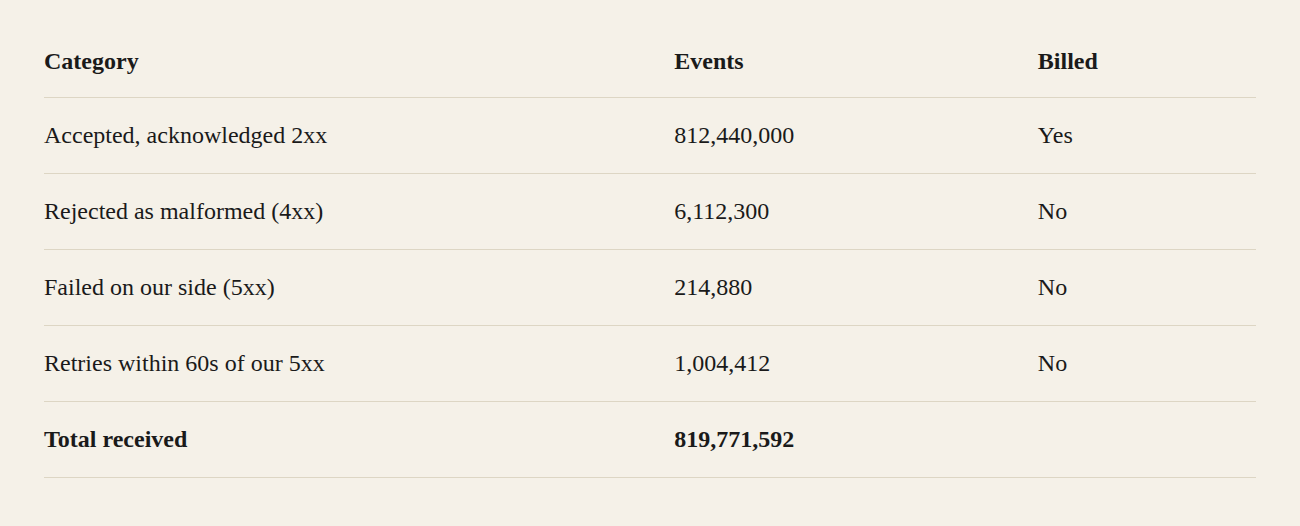
The customer had been counting everything their SDK sent, all 819.8M. The 7.3M difference, 0.89% of volume, is the entire dispute. It's visible in four minutes, on the call, by the person who picked up the phone.
Compare that to the trace on the previous page: same question, same correct answer, twenty days apart.
Example B: A rate card change, end to end
RevOps drops the events rate from $2.20 to $2.00 per million.
.png)
There are no engineering deployments, release windows, or code updates required.The approval chain is recorded on the object itself, so "who authorized this and when" is a field rather than an email search. Accounts on committed rates are excluded automatically rather than by someone remembering to exclude them.
Example C: A period-end tie-out
Closing March:
.png)
Invoiced plus unbilled equals rated, by construction rather than by reconciliation. The unbilled figure is a live balance throughout the month, not something assembled after close. The journal entry posts as one summarized batch with 11,842 linked detail lines, so the GL stays readable and the trail underneath it stays intact.
What to measure
If you are evaluating this approach (with us or anyone else), these are the operating metrics that move. It is worth baselining them before you start so the comparison is concrete:
.png)
(We won't tell you which of these will improve the most, because it depends entirely on where your current process leaks. Baseline them first.)
Where this isn't the right fit
- Flat-rate per seat billing: If you bill flat fees with no consumption component, most of this infrastructure is unnecessary machinery.
- Unreliable upstream metering: If your metering happens upstream in your own product and the incoming data is unreliable, downstream billing cannot fix that. Accurate billing requires an accurate meter.
- Bespoke, hand-negotiated contracts: If nearly every single contract features custom terms, expect real configuration work rather than instant self-serve setup.
- Low invoice volume: If your volume is low enough that a person can explain every line from memory, you have a spreadsheet problem, not a platform problem.
The point
Our previous post argued that transparency is how you keep customers who aren't afraid to scale their usage. That remains true, as it is the part that drives expansion revenue.
For the team operating billing day-to-day, however, transparency is something much simpler and more immediate. It is the difference between an invoice that defends itself and one that costs you three days, an engineer, and a quarter of aged receivables every time a customer asks a reasonable question.
Trust, but reconcile. Ideally in that order, and ideally without anyone having to ask.
.png)

.svg)


.svg)


.svg)