.svg)


Usage-based pricing asks something unusual of a customer: sign first, find out what you owe later.
That's a real leap of faith. And every month, the invoice either confirms it was justified or quietly starts eroding it. Roadmaps and uptime dashboards get all the attention, but the bill is the one artifact every customer reads closely, every single month. It's where trust is actually settled.
Finance and revenue leaders invest enormous energy in pricing strategy, but often overlook how that pricing is experienced at the moment it becomes real: the invoice. A pricing model can be perfectly rational on paper and still fail commercially if customers cannot predict, verify, or understand what they are being charged.
For any company offering usage-based pricing, billing should be treated as a customer-facing product experience, not just a back-office function. Transparency, predictability, and clarity are essential.
Here are five operational principles every business can adopt to make billing a foundation for long-term customer trust:
1. Publish clear, accessible pricing
Every rate, tier, and unit should be visible on a public pricing page, with no "contact sales" wall blocking the numbers a buyer actually needs. That transparency lets prospective buyers model their own costs before ever signing a contract.
For example, if a team ingests 4 million events a month with 200 GB of retained storage, they should be able to lay out the math themselves before talking to sales:
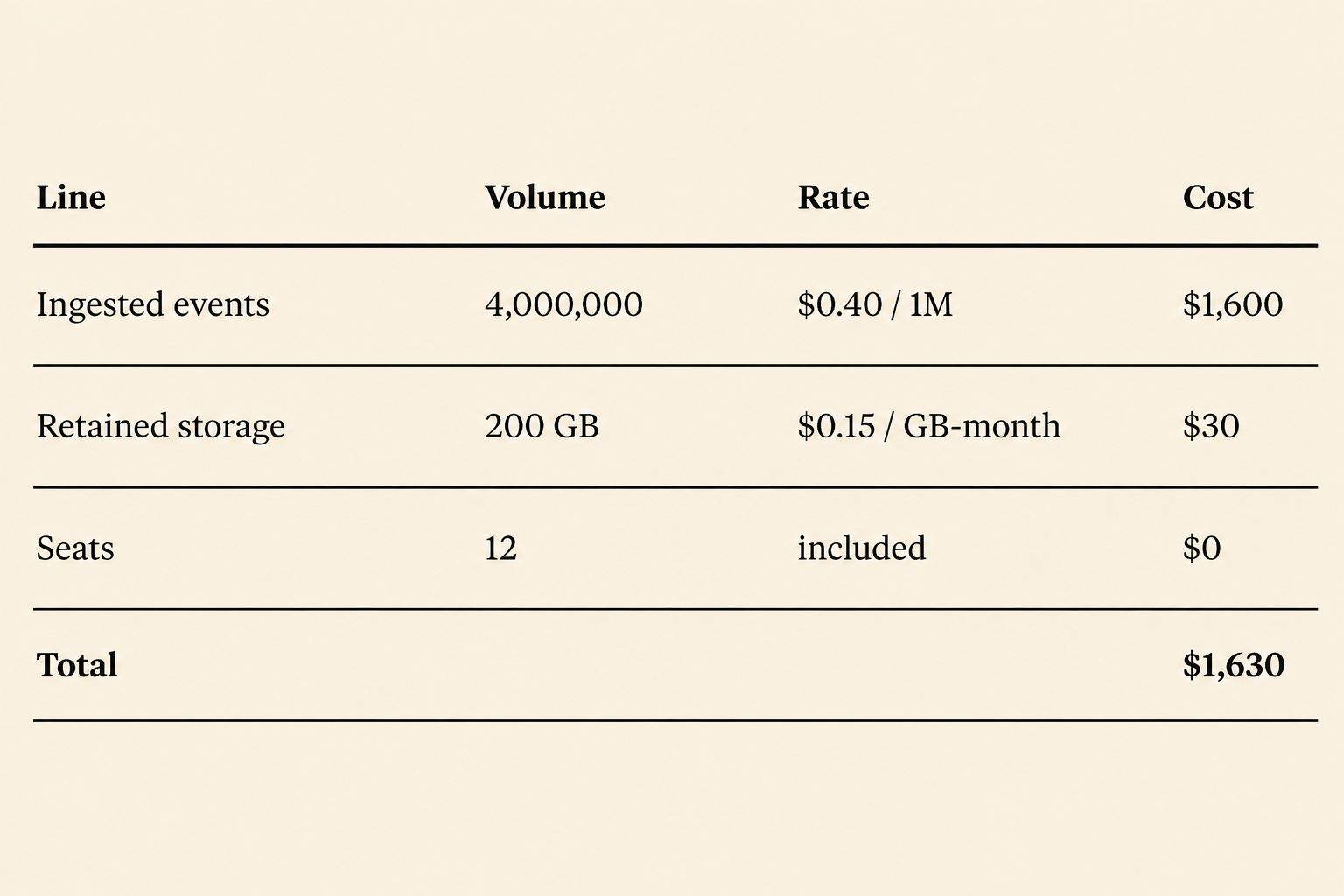
No per-seat surcharge discovered in month three. No mystery "platform fee" line appearing at renewal. When buyers cannot model their costs up front, vendor trust breaks down before the relationship even begins. A pricing page that hides its numbers tells a buyer everything they need to know about how the rest of the partnership will go.
2. Provide real-time, understandable metering
Customers should not find out what they spent only when the invoice arrives. Offer live usage dashboards that update continuously and match the dimensions used in billing and not a different set of aggregates that happen to be convenient for you.
Publish precisely how each unit is counted.
- Billable vs. Non-Billable Events: A billable event is accepted at ingest and acknowledged with a 2xx response. Malformed payloads rejected at 4xx are not billed, nor are 5xx vendor failures or retries made within 60 seconds of a failure.
- Storage Calculations: Storage is sampled hourly and averaged across the month, ensuring customers pay for what they held on average, not their peak hour.
- Fair Compute Floors: Compute rounds to the nearest second with a one-second minimum, avoiding 60-second floors that quietly triple the cost of short jobs.
- Never Billed Items: System health checks, dashboard queries, API calls to read usage data, and usage consumed during a declared vendor incident are never billed.
When definitions change, communicate proactively with dated release notes and concrete examples, not silent edits.
3. Deliver invoices that explain themselves
An invoice should answer "Why this number?" without a support ticket. Every line should drill down to the raw usage records behind it, showing the exact math from units to dollars.
Proration is where traditional billing usually breaks down. For instance, if a customer upgrades from Standard to Scale on day 12 of a 30-day month, the invoice should show three distinct, transparent line items rather than a single blended mystery figure:
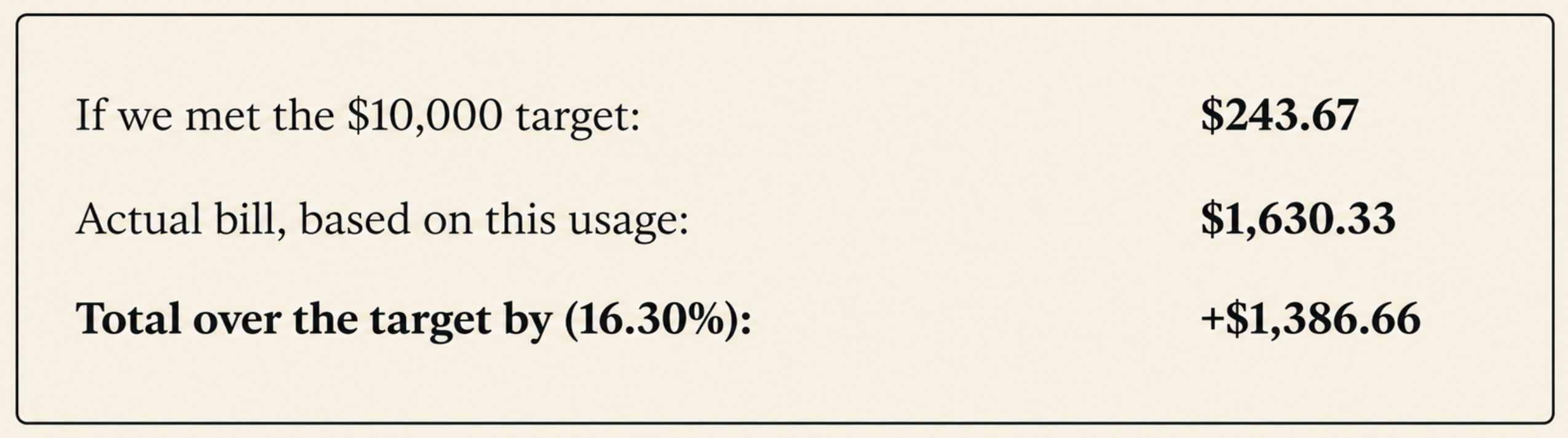
Credits, discounts, and adjustments each get their own line. Annual invoices still itemize unit rates so renewals cannot quietly reprice a metric under cover of one large number.
When billing errors happen, proactive resolution is essential: issue automatic credits to affected accounts, send an explanation before the customer notices the discrepancy, and publish an account of what went wrong.
4. Prevent surprises with monitoring and alerts
Bill shock is almost always the result of insufficient monitoring. Companies know their customers’ usage patterns and should set up alerts for anomalies, budget thresholds, and projected month-end totals. Offer customers options for hard spending caps if needed, and ensure that any unusual usage is flagged and communicated quickly, ideally before the invoice is generated.
Consider a common scenario: a customer ships a bad deploy at 2:00 AM on a Saturday, a retry loop takes hold, and ingest runs at 40x baseline.
- The Industry Default: The customer finds out on the 19th of the following month via a $61,000 invoice, leading to weeks of angry disputes.
- The Better Way: An anomaly alert fires 15 minutes in to the on-call engineer, identifying the offending source. The total cost of the incident remains around $90.
Building automated guardrails directly into billing infrastructure (such as real-time anomaly alerts, budget thresholds at 50%, 80%, and 100%, daily projected month-end totals, and optional hard caps) stops disputes before they start.
5. Eliminate vendor traps and dark patterns
Build trust by removing the sneaky operational traps that drain customer goodwill.
- Do not trigger automatic tier upgrades when customers exceed their usage temporarily.
- Make sure unused commitments do not expire at year end without clear communication. If commitments roll over, explain this. If they do not, notify customers directly.
- Never charge egress fees for leaving. Make full data export free, self-serve, and easy to access without requiring a sales call.
- Keep pricing stable throughout the contract term. Hold committed rates for the entire duration, and provide at least 90 days’ notice before making any changes at renewal.
Why This Matters
A cynical view of usage-based pricing is that ambiguity can be profitable. Vague metering, unclear tiers, and surprise overages may increase revenue in the short term but ultimately hurt long-term growth. This approach tends to create a certain type of customer: one who audits every invoice, budgets defensively, limits their usage below what they actually need, keeps a migration plan ready, and responds quickly to calls from competitors. Squeezing a few extra points of margin out of confusion costs your business the expansion revenue that usage-based pricing is meant to deliver.
It is far better to have customers who feel confident increasing their usage because they are not afraid of the bill.
Transparency is not just a value listed on an About page. It means offering a pricing page with real numbers, a meter that customers can monitor, alerts that warn before problems occur, and invoices that clearly show the math behind every charge. When this happens month after month, transparency becomes routine and trust becomes inevitable.
This is how trust is built, one invoice at a time.
.png)

.svg)


.svg)


.svg)