.svg)

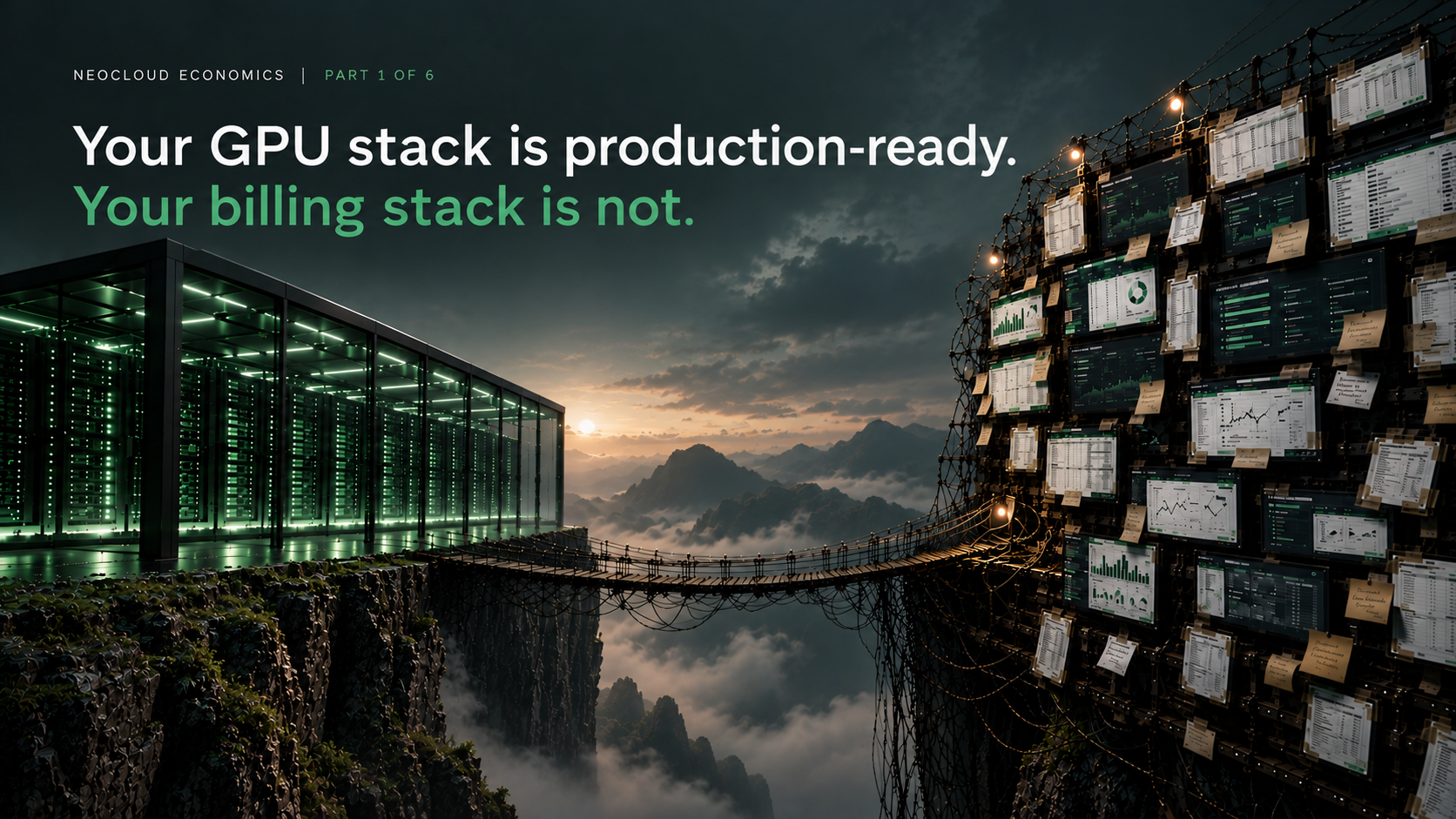
Neocloud Economics, Part 1 of 6
Then the product evolves. You add inference. Then model hosting. Then token consumption. Then the first serious enterprise contract lands and the procurement team wants a single invoice that covers a prepaid wallet, hourly infrastructure charges, per-token consumption, and an application subscription, all for one tenant, all in one statement, with real-time draw-down and automated overage enforcement.
Your billing system was designed to handle one of those things. Not all four simultaneously. So your finance team builds a workaround. Then patches the workaround. Then hires someone to maintain the patch. Then loses the renewal conversation because the commercial operations did not look production-ready to the enterprise buyer.
This is the moment every neocloud reaches. The product is working fine. What has failed is the commercial architecture underneath it.
Neocloud revenues exceeded $25 billion in 2025, growing over 200 percent year on year. The market is scaling at a pace most commercial stacks were never designed to keep up with.
As venture capital and enterprise budgets pour into specialized AI infrastructure, providers are transitioning from simple bare-metal GPU rental to multi-layered service models. Yet, legacy billing engines built for SaaS or traditional cloud computing choke on the multi-dimensional nature of AI workloads. They cannot gracefully merge usage-based metering with flat-rate reservations or dynamic token counting without shattering into fragile, manual workflows.
Building a foundational commercial layer
The operators who avoid this operational wall are not the ones who moved faster on hardware procurement. They are the ones who invested in revenue infrastructure early, treating it with the same architectural gravity as compute, networking, and power.
From infrastructure to applications, the AI economy stacks into five distinct layers:
- Layer 1: Bare-Metal and GPU Infrastructure (Raw compute, clusters, and high-density hosting)
- Layer 2: Orchestration and Container Management (Kubernetes, scheduling, and cluster optimization)
- Layer 3: Model Hosting and Inference Endpoints (Managed runtimes and deployment pipelines)
- Layer 4: Token-Level Consumption and Metering (Dynamic tracking of input and output tokens alongside execution metrics)
- Layer 5: Application and Agent Workflows (End-user applications, agentic frameworks, and SaaS wrappers)
You may not run all five layers on day one. But the revenue infrastructure beneath them should already be in place. When revenue infrastructure acts as an integrated foundation, each new layer activates on the stack you already run, requiring no frantic replatforming, no brittle database patches, and no new internal seams to manage.
What layer is your commercial model actually designed for today?
In the next post in this series, we will examine tokens as the atomic unit of AI value delivery, and why capturing revenue from them cleanly is a problem hardly anyone has truly cracked.
.png)
.svg)


.svg)


.svg)