.svg)

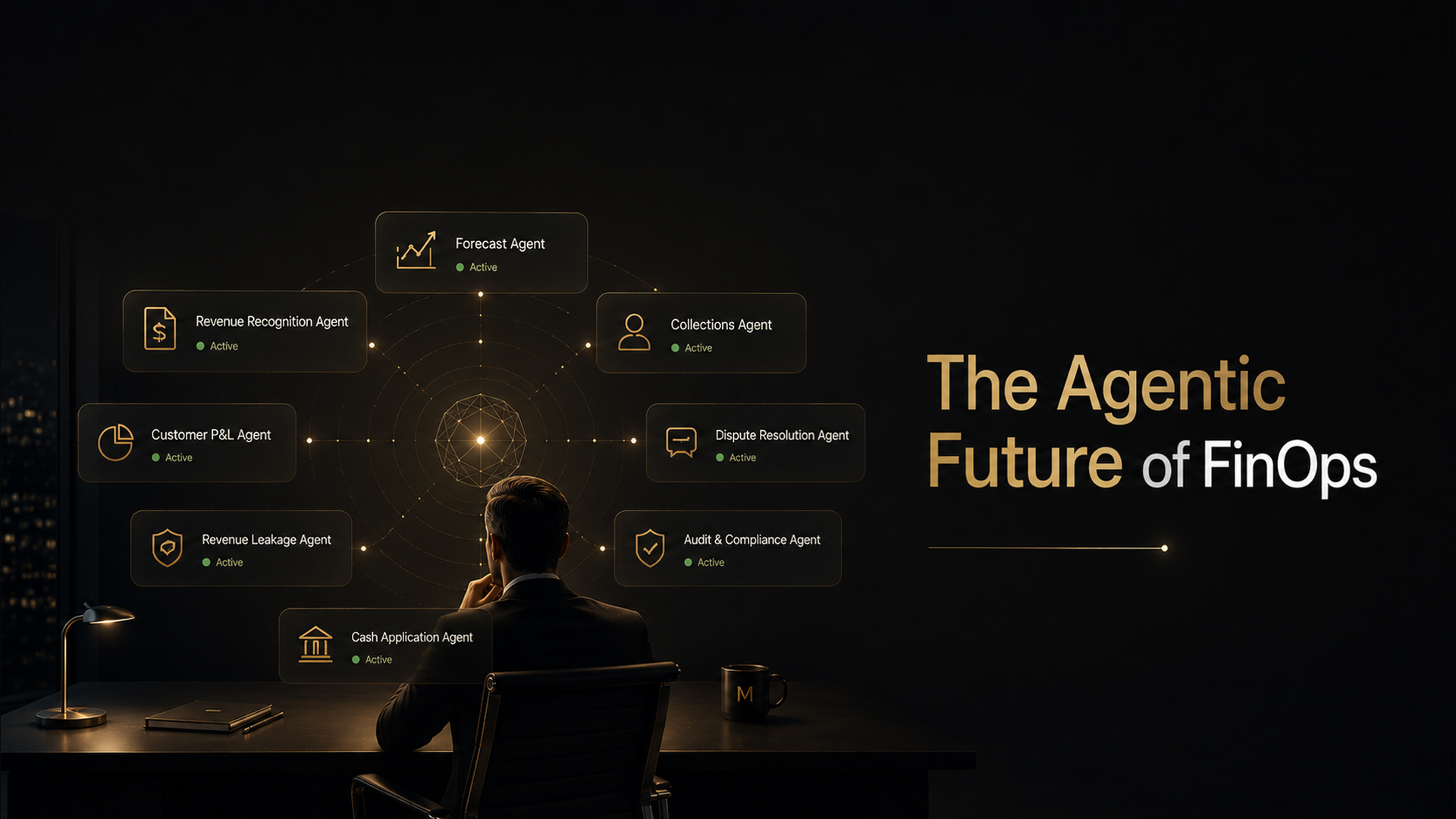
The finance leader of 2027 will not manage a team of 50 finance professionals doing reconciliation and reporting. They will oversee a fleet of specialized AI agents handling revenue recognition, billing reconciliation, dispute resolution, and forecasting, directed by a much smaller team of strategic finance leaders. This is not a distant projection. The functions that make up the traditional finance back office are already being rebuilt agent by agent, and the finance leaders who understand what that changes about the role, not just the headcount, will be the ones who define the next era of the function.
The back office is already being agentified
The quiet truth is that the transformation has started without a memo announcing it. Function by function, the manual work that has always defined the finance back office is being handed to agents that operate inside policy:
- Revenue recognition. Once a month-end scramble of spreadsheets and manual tie-outs, it is increasingly handled by systems that apply recognition rules continuously as usage and contract events occur, surfacing only the exceptions that need a human eye.
- Collections and dunning. Historically a manual chase of every late account, it now runs as adaptive sequences that segment accounts by risk and act automatically, freeing the team to focus on high-value recovery.
- Dispute resolution. What used to consume days of AR time per case is compressed into minutes as agents match disputes to their root cause in usage or contract data and recommend a resolution.
- Invoice and cash reconciliation. Reconciling metering, invoicing, wallet balances, and partner settlements once took days, and incoming payments had to be matched by hand. Both now run in the background.
- Forecasting. The quarterly modeling exercise is shifting to a live, continuously updated view rather than a snapshot that is already stale by the time it is finished.
None of these are future capabilities. They are in production today, and each one removes a category of repetitive work from the finance floor.
Specialized agents, not one monolithic AI
The mistake is to imagine "AI for finance" as a single oracle that does everything. The real architecture is a roster of narrow, specialized agents, each accountable for one function and each operating inside policy. A revenue recognition agent applies your rec rules and flags exceptions. A collections agent segments overdue accounts and runs adaptive follow-up. A forecast agent models best and worst case against live revenue and cost data. An audit agent maintains an immutable, explainable record of every action so that traceability is automatic rather than reconstructed after the fact. Specialization is what makes the system both auditable and trustworthy, because each agent's mandate, limits, and outputs are explicit and reviewable, rather than buried inside one opaque model.
The strategic finance leader's role changes, not disappears
Here is the part that matters most, and it is easy to misread. Agentifying finance operations does not shrink the finance leader's importance. It relocates it. The work moves from process oversight to agent oversight, a more strategic form of control. Instead of asking whether the close will finish on time, the finance leader asks whether the policies the agents enforce are the right policies, whether the guardrails match the company's risk appetite, and where the agents should be granted more autonomy or held back. The finance leader stops supervising the execution of tasks and starts governing the system that executes them. That is a promotion in scope, disguised as automation.
The cost transformation is a reallocation, not just a cut
The headline that gets attention is finance OpEx reduction, and it is real. But the more interesting story is where the freed capacity goes. When agents absorb reconciliation, dunning, and manual dispute work, the savings do not have to leave the finance function. The smartest finance leaders are reinvesting them into revenue intelligence: strategic analysis, margin diagnostics, scenario planning, and the kind of forward-looking work that finance rarely had time for when the back office consumed the calendar. The transformation is less about doing the same work with fewer people and more about redeploying finance talent from processing the past to shaping the future.
Board reporting moves from monthly to real time
The monthly close exists because reconciliation used to take weeks, so the board settled for a snapshot that was already stale by the time it was presented. Agentic finance collapses that lag. When revenue events, entitlements, and costs are reconciled continuously, the board conversation shifts from explaining what happened last month to deciding what to do this quarter. Real-time visibility into margin by segment, net revenue retention, collection velocity, and forecast accuracy changes the tempo of financial leadership. The close stops being an event and becomes a state the business is always in.
What this looks like in practice
Consider a SaaS company at $200M ARR that restructured its finance function after deploying agentic revenue operations. Over 18 months, finance headcount moved from 32 to 19 professionals. Monthly close time compressed from 14 days to 3. Forecast accuracy tightened from roughly plus or minus 15% to plus or minus 5%. Critically, the reallocated budget did not simply vanish. It funded a four-person Revenue Intelligence team dedicated to strategic analysis, exactly the higher-value work the old operating model never had the bandwidth to fund. That is the shape of the agentic finance transition: fewer people processing, a leaner team doing sharper work, and a close that is faster and more accurate at the same time.
Where Monetize360 fits
This is precisely the operating model M360 Agents was built for. Finance leaders get a roster of more than 30 autonomous, governed agents built for exactly these functions: revenue leakage detection, invoice reconciliation, billing dispute resolution, smart dunning, cash application, credit risk, customer-level P&L, revenue forecasting and capacity planning, policy compliance, and an audit trail agent that keeps every decision traceable. The agents run on Mbrix, which reads live from the ERP, CRM, billing, and metering systems you already use, so adopting them does not mean replatforming the stack your finance team already trusts. Above it all, RevenueOS gives you one governed control layer across pricing, entitlements, billing, and controls.
And no vendor's out-of-the-box roster covers every edge case a real finance operation runs into. That is what Mbrix is for. Its no-code builder lets your team extend the existing agents or build entirely new ones for your specific revenue model, without an engineering dependency and without waiting on a product roadmap. The agents handle the finance operations you have in common with everyone else. Mbrix handles the ones that are uniquely yours. Together they give the finance leader both a running start and room to grow into the operating model finance is heading toward.
.png)

.svg)


.svg)


.svg)