.svg)

The single biggest blocker to agentic Q2C adoption is not capability but trust. CFOs and auditors will not accept AI agents posting journal entries or sending invoices without a clear answer to one question: how do we govern this? Here is how leading companies are solving the trust problem, and it has very little to do with slowing AI down.
Why trust lags behind agentic Q2C
A survey of more than 1,500 CFOs and senior finance leaders released this week by Avalara found that 92% feel career pressure to prove AI agent ROI, yet only 7% say their organization prioritizes governance over deployment speed. Nearly a third have not updated their internal controls in the past year to reflect agents taking or recommending actions, and 44% say they are only somewhat confident they could explain an AI agent's decision to an auditor or regulator. The uncomfortable finding underneath all of this: almost one in four respondents said accountability for a significant AI agent error would be unclear, or would sit with no one at all. Speed has outrun governance, and finance leaders know it.
The same research points to the fix. When asked what would most increase their confidence in expanding AI agents, respondents ranked audit-ready documentation for every AI-driven action and agents operating within existing systems of record among the top answers. In other words, the industry already knows what trust requires. Very few have built it yet.
Four levels of human involvement, and most companies pick blindly
Before you can design governance, you need a shared vocabulary for how much control a human retains. The phrase “human in the loop” describes four very different postures.
- In-the-loop. A human must approve every action before it executes. Safest, slowest, and appropriate for high-stakes or novel decisions.
- On-the-loop. The agent acts, and a human monitors in real time with the ability to intervene before consequences compound.
- Over-the-loop. The agent acts autonomously within policy, and a human reviews a sample or an exception queue after the fact.
- Out-of-the-loop. The agent acts entirely on its own within its mandate, with no routine human review, only escalation on defined triggers.
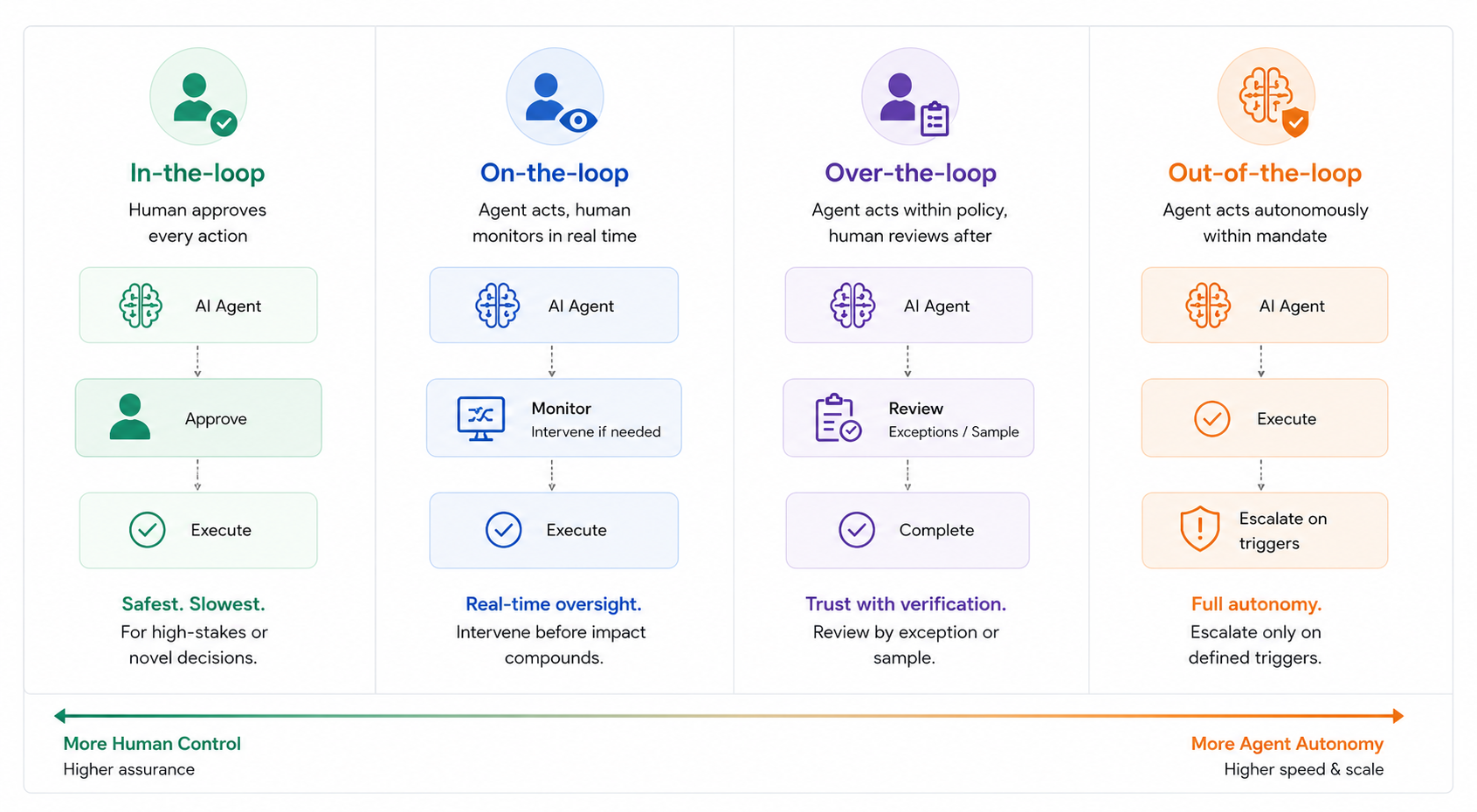
Most companies do not choose a level deliberately. They default to whatever their first pilot happened to look like, then discover months later that that posture cannot scale or cannot pass an audit. Governance design starts with picking the right level for each decision type on purpose, not by accident.
Approval thresholds turn philosophy into policy
Once you know which level applies, you need thresholds that are specific enough for an agent to execute without ambiguity: dollar amounts that trigger escalation, margin floors an agent cannot cross, and term boundaries it cannot offer. The best-designed thresholds are tiered, not binary. For example: a refund under a set amount is handled autonomously. A larger one escalates to a finance manager. Anything above a second ceiling goes to the Controller. Tiering matters because it enables the organization to capture the speed of automation on the high-volume, low-risk majority of cases, while ensuring a human is involved in decisions that carry real exposure.
What auditors and regulators actually expect
Auditors do not need to understand your model architecture. They need to reconstruct, for any decision, what happened, why, under what policy, and who or what approved it. That means every agent action needs a timestamped, immutable record: the input data, the policy applied, the output, and the outcome. This is precisely the gap the Avalara research surfaces when 44% of finance leaders say they could only somewhat explain an agent's actions to a regulator. Building the audit trail after the fact, once a regulator asks, is the wrong order of operations. It has to be a byproduct of how the agent operates, not a report someone assembles under deadline.
Exception handling without breaking the workflow
The measure of a well-designed agent is not how often it acts autonomously. It is what happens when it hits a case it was not built to handle. A well-governed agent recognizes the edge of its own mandate and escalates cleanly, with full context attached, rather than guessing or stalling the process. The workflow should not break when a case escalates. It should simply change hands, with the human picking up exactly where the agent left off, not starting over.
Policy as code is what makes any of this consistent
None of the above works if business rules live in a policy document that agents cannot read. Policy as code means your discount limits, margin floors, approval chains, and regulatory constraints are encoded directly into the system agents operate in, so every agent applies the same rule the same way, every time, and any change to policy takes effect everywhere at once. This is also what makes governance auditable rather than aspirational. You can show a regulator the rule, not just describe it.
What this looks like in practice
A publicly traded SaaS company deployed agentic billing dispute resolution with exactly this kind of tiered structure. Agents could approve refunds up to $5,000 autonomously, escalate disputes between $5,001 and $25,000 to a finance manager, and route anything larger to the Controller. In year one, agents resolved 73% of disputes autonomously with zero audit findings, and dispute resolution time dropped from 11 days to 8 hours. That result did not come from giving the agents more autonomy. It came from designing the thresholds precisely enough that autonomy and control could coexist.
Configurable Governance with Monetize360
Monetize360 applies these principles through a configurable governance layer that puts you in control. M360 Agents operate on configurable thresholds you define, not fixed defaults: dollar limits, margin floors, and approval chains that match your risk appetite exactly. A Discount Guardrail Agent and Policy Compliance Agent enforce those thresholds at the point of decision, not after the fact. An Audit Trail Agent maintains a full, explainable record of every action, so the answer to "how do we govern this" is built into the architecture rather than bolted on afterward. And because this runs on Mbrix, which reads live from the systems of record you already trust, governance does not require replatforming, only configuration.
Full autonomy is not the goal. Configurable autonomy with full explainability is, and it is the only version of agentic Q2C that a CFO, a Controller, and an auditor can all sign off on at the same time.
Design your governance framework before you scale. The teams getting the most out of agentic Q2C aren’t the ones who just deployed the fastest, but those who mapped decision types to human-involvement levels, set clear thresholds, and built an audit trail their auditors would actually accept, before scaling. Risk-averse buyers don’t need to be talked into AI. They need a structure they can trust—and that structure is easier to see than to describe. See how Monetize360 builds configurable autonomy and full explainability into every agent. Schedule a demo.
.png)
.svg)


.svg)


.svg)