.svg)

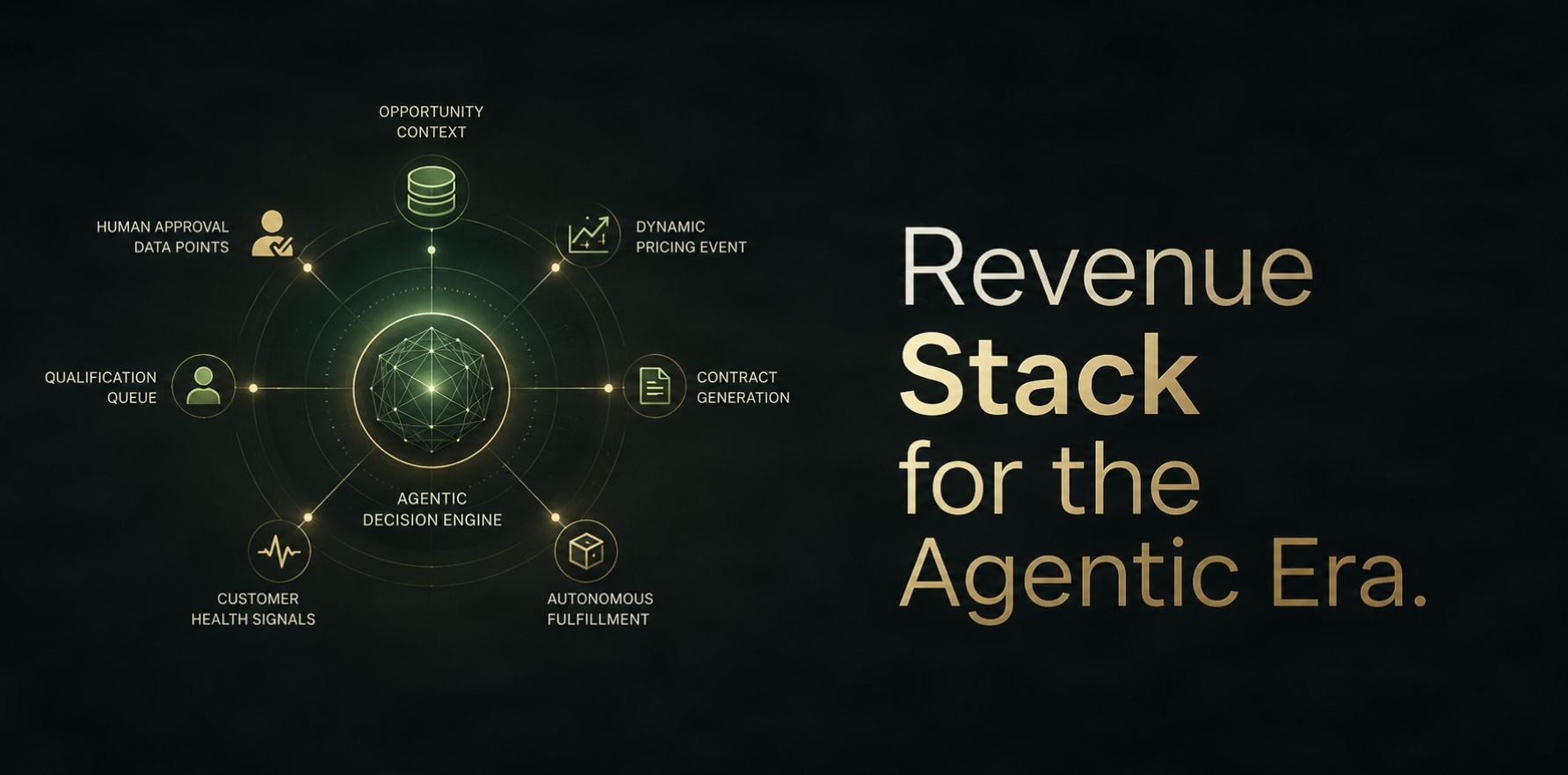
Your current revenue stack was built for human workflows: queues, approvals, handoffs. That was the right design when a human sat at every decision point. It is the wrong design the moment an agent does. Agentic quote-to-cash isn't a faster workflow engine with an LLM bolted on. It demands a fundamentally different architecture that is event-driven, context-aware, and built for autonomous decision-making. Most teams evaluating 'AI for RevOps' are about to make a category error: they're treating AI as an add-on to workflows built for humans, when the agentic era actually demands RevOps rebuilt for AI agents from the ground up. The good news is that fixing this doesn't mean tearing out the systems you already trust.
The mismatch workflows can't absorb
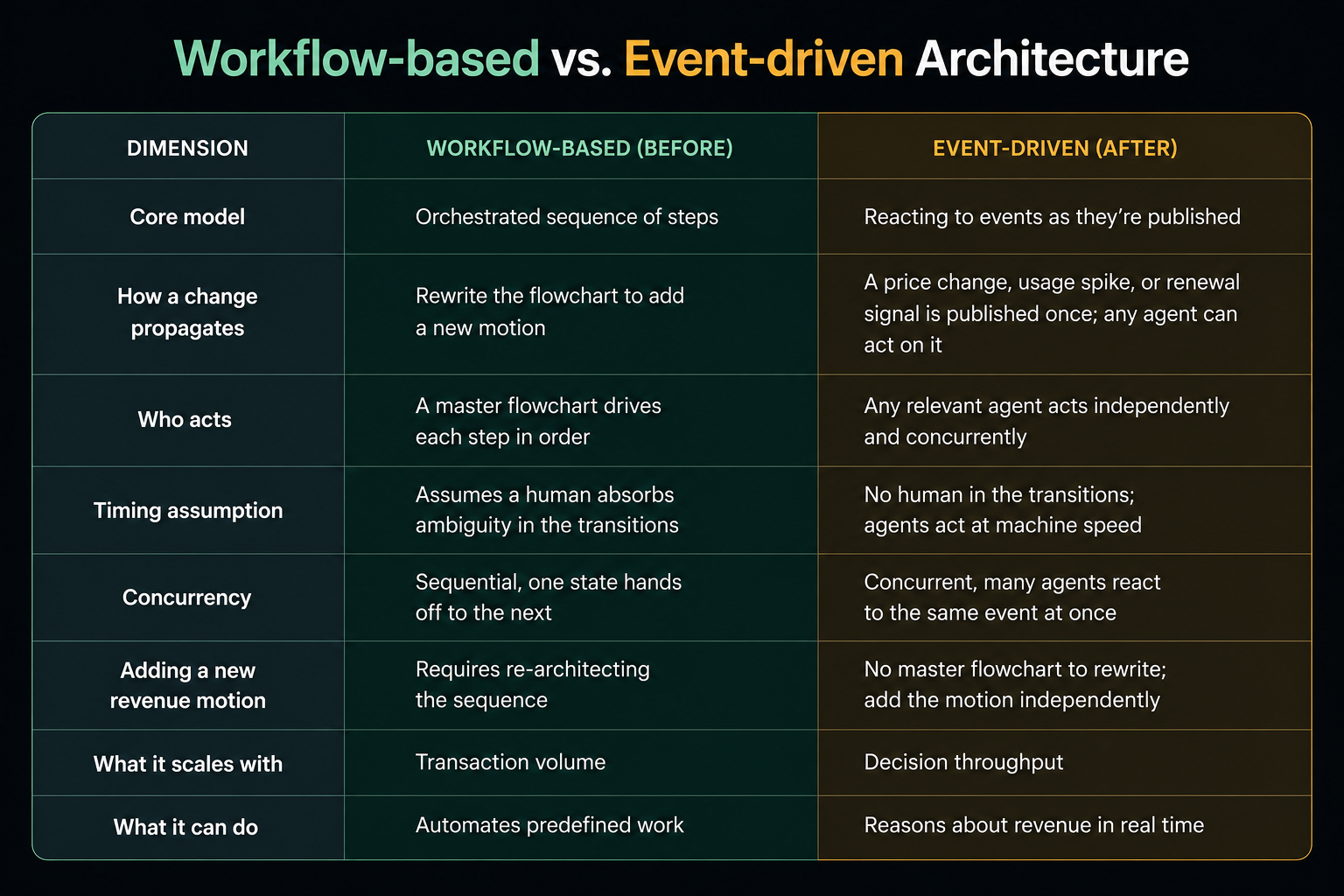
Every enterprise embedding AI is running into the same structural problem. Costs now scale with consumption, whether tokens, GPU hours, usage events, or outcomes, but the revenue architecture underneath still thinks in seats, tiers, and month-end reconciliation. That gap erodes margin, and it compounds at scale. Workflow engines make it worse, because they encode revenue operations as a fixed sequence of states: a quote enters a queue, waits for approval, hands off to billing, hands off to rev rec. The sequence is the logic, and it assumes a human will absorb every ambiguity the flow didn't anticipate. Agents don't wait in queues, and they don't tolerate a system whose intelligence lives in the transitions between steps rather than in the steps themselves.
Event-driven is the architectural shift
The move is from orchestrating steps to reacting to events. In an event-driven design, a price change, a usage spike, a contract amendment, or a renewal signal is published as an event, and any agent with a relevant policy can act on it independently and concurrently. There is no master flowchart to rewrite every time the business adds a motion. This is what lets the system scale in decision throughput rather than just transaction volume, and that distinction separates platforms that merely automate from platforms that can actually reason about revenue in real time.
The revenue context graph
Autonomy is only as good as the shared state agents operate on. If a pricing agent, a billing agent, and a collections agent each hold a private, stale view of the customer, autonomous decisions compound into autonomous errors. The answer is one governed data model: a single, trusted representation of every quote, contract, entitlement, and transaction that every agent reads from and writes to. CPQ, billing, and revenue recognition stop being systems you reconcile after the fact and become views over one coherent state. When an agent adjusts a price, the billing and rev-rec implications are already visible in the same model, not discovered three systems later.
Agents that use your existing systems as tools
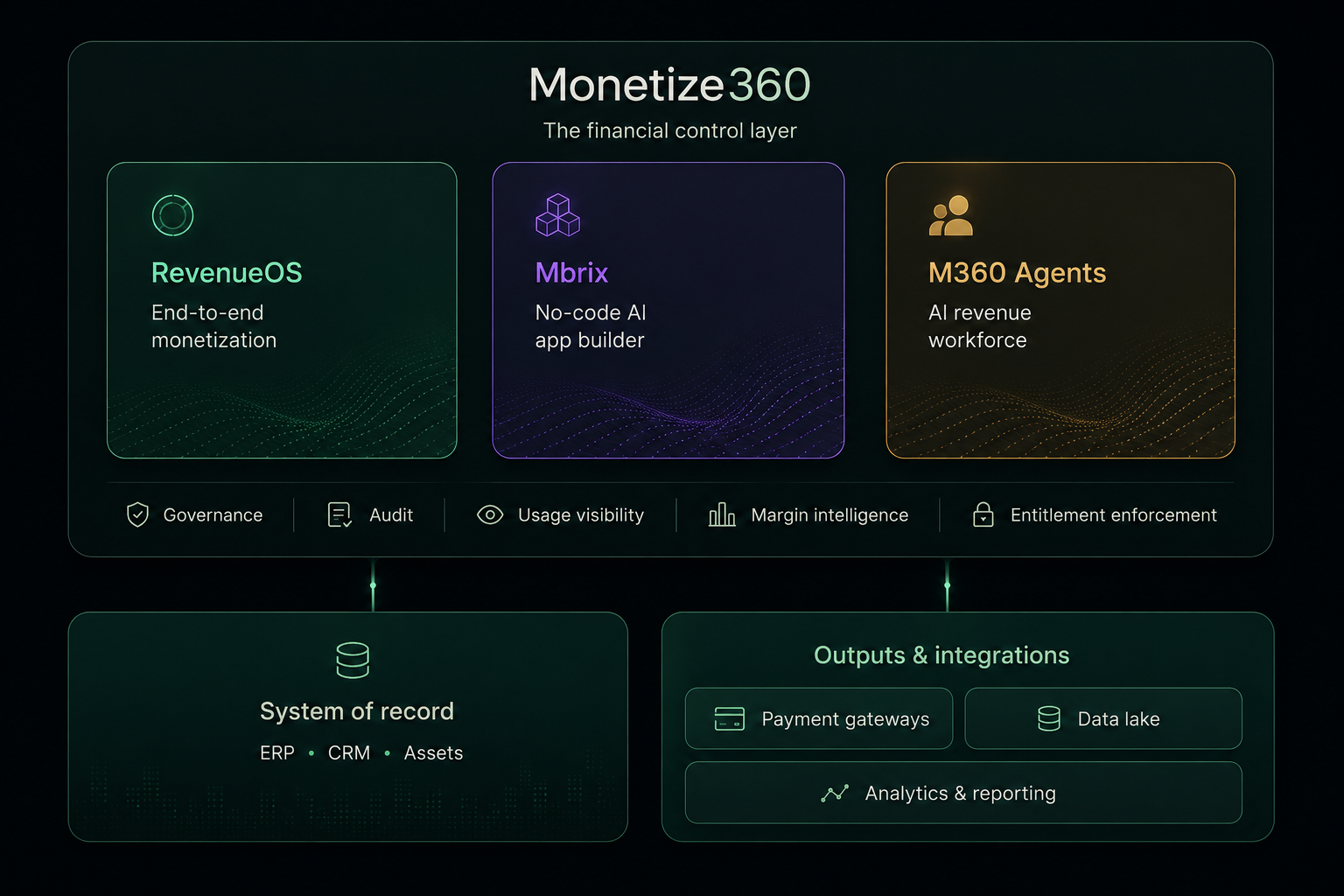
Here is the part most "rip and replace" pitches get wrong: you don't need to replace your stack to make it agentic. The right architecture sits above your infrastructure as a control layer, and the agents read live from the ERP, CRM, billing platform, and usage metering you already run, treating each as a tool they call rather than a system they supplant. Deterministic business math stays in your deterministic engines, and the agent supplies the judgment about which tool to call, with what inputs, under what conditions. Your systems of record become leverage rather than liability, and your institutional knowledge and custom workflows survive the transition.
Guardrails, policy, and audit as first-class layers
Autonomy without enforceable policy is a liability, and finance leaders are right to insist on it. In a sound agentic architecture, every autonomous decision passes through a policy layer before it commits, checked against your thresholds, your approval chains, your margin floors, and your regulatory and revenue-recognition constraints. A Discount Guardrail Agent enforces pricing policy at the point of approval, not after the deal is signed. A Policy Compliance Agent continuously validates that pricing, billing, and collections conform to internal and regulatory rules, flagging deviations before they become audit findings. An Audit Trail Agent maintains an immutable, explainable record of every decision, so autonomy is defensible to a CFO and an auditor at the same time. Guardrails belong in the architecture as a distinct, auditable layer, not scattered as conditionals inside individual agents.
How Monetize360 assembles it
This is the design Monetize360 is built around. RevenueOS is the financial control plane that sits above your existing infrastructure, unifying pricing, entitlements, billing, and controls across the systems you already run, with one revenue logic layer, one governed data model, and one policy and audit layer. M360 Agents library supplies more than 30 autonomous, governed agents across the revenue lifecycle, from deal desk and metering to billing, collections, and executive insight, each acting on the rules you define with full traceability. Mbrix, the no-code builder and orchestration layer, closes the gap where most AI projects stall, which is the space between prototype and production. Together they let you deploy agent-native monetization without replatforming. The rip-and-replace era is over.
What this looks like in practice
The payoff is not incremental, and it's easiest to see in the shape of the change. When a platform moves from a monolithic workflow engine to an agent-based design, it stops scaling on transaction volume and starts scaling on decision throughput, handling far more concurrent decision events and supporting custom agent policies per customer, something a fixed workflow model simply cannot express. Quote generation stops being a multi-step, multi-second queue and becomes a near-instant decision. That is the difference between a system that processes work and one that makes decisions at machine speed, per tenant, without a rebuild for every new motion.
Where to start
If you're weighing whether to extend your workflow engine or move to an agent-native design, that decision deserves architectural scrutiny before a platform recommendation. Monetize360's solutions architects run an Agentic Architecture Review, a working session mapping your current stack against an agent-native reference architecture, with the failure modes and migration path made explicit. Book one before your next platform decision.
.png)
.svg)


.svg)


.svg)