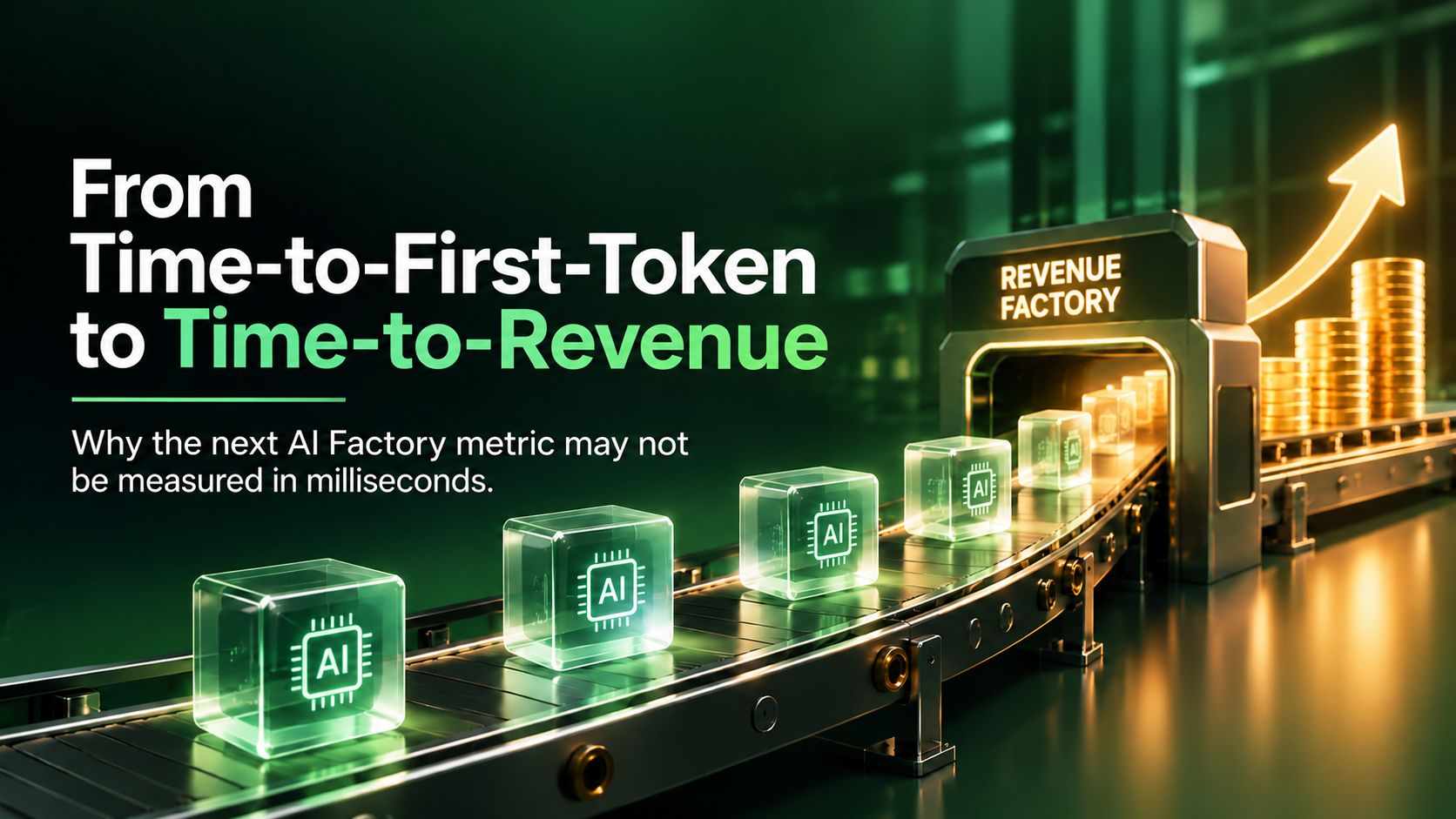
Why the next AI Factory metric may not be measured in milliseconds.
A conversation with Murali Saravu, Founder, Monetize360 and Viroopax “Viroo” Mirji, Chief Strategy Officer & SVP Partnerships, Monetize360
AI infrastructure has become extraordinarily good at measuring speed. Time-to-first-token tells us how quickly a model begins responding. Tokens per second tells us throughput. Utilization tells us how efficiently expensive infrastructure is being used.
These are important metrics. They represent years of difficult engineering work.
But there is another clock that starts running at exactly the same time: how long does it take for that AI service to become something that can be priced, metered, governed, billed and ultimately recognized as revenue?
That clock is rarely on the dashboard.
The industry has spent years optimizing milliseconds. Now we need to shorten the months. Time-to-first-token tells us whether the technology is ready. Time-to-revenue tells us whether the business around it is ready. - Murali Saravu, Founder
That gap — between producing intelligence and commercializing it — is becoming one of the more interesting problems in the AI infrastructure economy.
1. AI infrastructure is ready. Is the business?
The first phase of the AI Factory has understandably been dominated by infrastructure: build capacity, improve utilization, reduce inference latency, increase throughput and optimize cost per token.
As AI factories move from building infrastructure to delivering services, however, the economic question changes. It is no longer only: How efficiently can we produce intelligence? It is also: How effectively can we turn that intelligence into a commercial service?
A technically live AI service is not necessarily commercially live. Someone still has to decide what is being sold, what constitutes consumption, who is entitled to consume it, how it is priced, how usage is measured, what happens when thresholds are crossed, how partners participate in the economics, and eventually what appears on the invoice.
That is why we think Time-to-Revenue deserves to sit alongside Time-to-First-Token. One measures the readiness of the infrastructure. The other measures the readiness of the business.
2. One AI Factory. More ways to monetize.
The AI Factory business model is expanding beyond GPU capacity. Providers can monetize dedicated or shared compute. They can charge for inference and tokens. They can package models and APIs. They can offer AI services, agents and marketplaces. Increasingly, they can explore commercial models tied to the work performed or outcomes delivered.
CAPACITY → CONSUMPTION → SERVICES → OUTCOMES
Each step creates more economic opportunity. It also creates more commercial complexity.
A GPU-hour is relatively straightforward to price and reconcile. A model call may vary by model, region, service tier or SLA. An agent may invoke several models and tools before completing one task. A marketplace transaction may involve multiple parties that need to participate in the revenue. An outcome-based service introduces an even harder question: what exactly constitutes “done”?
The commercial system therefore has to understand more than usage. It has to understand the commercial meaning of usage.
The opportunity is not simply to bill for more units. As AI factories move from capacity to consumption, services and eventually outcomes, the commercial model becomes more dynamic. Pricing becomes conditional, consumption becomes continuous, and partner economics become more complex. - Viroo Mirji, Chief Strategy Officer & SVP Partnerships[
3. The commercial challenge begins between consumption and finance.
Revenue leakage rarely happens because one system completely fails. It happens in the seams.
An AI service records consumption. A metering system interprets it. Commercial rules determine a rate. Entitlements establish whether that consumption was authorized. Wallets or credits may change the amount payable. Billing converts the event into a charge. Settlement determines who gets what. Finance eventually has to reconcile the whole thing.
CONSUME → METER → ENTITLE → RATE → BILL → SETTLE → RECONCILE
Every handoff creates an opportunity for commercial intent and actual consumption to diverge. Usage can be dropped or duplicated. The wrong rate can be applied. Credits may not reconcile. Entitlements can drift from contracts. Partner shares can be calculated differently from the customer charge. Correct usage can still become a disputed invoice.
Traditional systems are often very good at answering the question they were built to answer. The problem is that no single system necessarily owns the commercial event end to end.
That is why revenue leakage often cannot be found by looking harder inside billing, CRM, contracts or finance individually. It lives between them. And every unresolved seam adds time between consumption and revenue.
4. The commercial layer around the five-layer stack.
The technology stack beneath the AI Factory has advanced remarkably. NVIDIA’s five-layer framing — energy, chips, infrastructure, models and applications — captures the extraordinary amount of technology required to produce and deliver AI at scale.
But producing an AI service and commercializing that service are different problems.
Monetization complements the five-layer stack by connecting AI-service consumption to commercial operations.
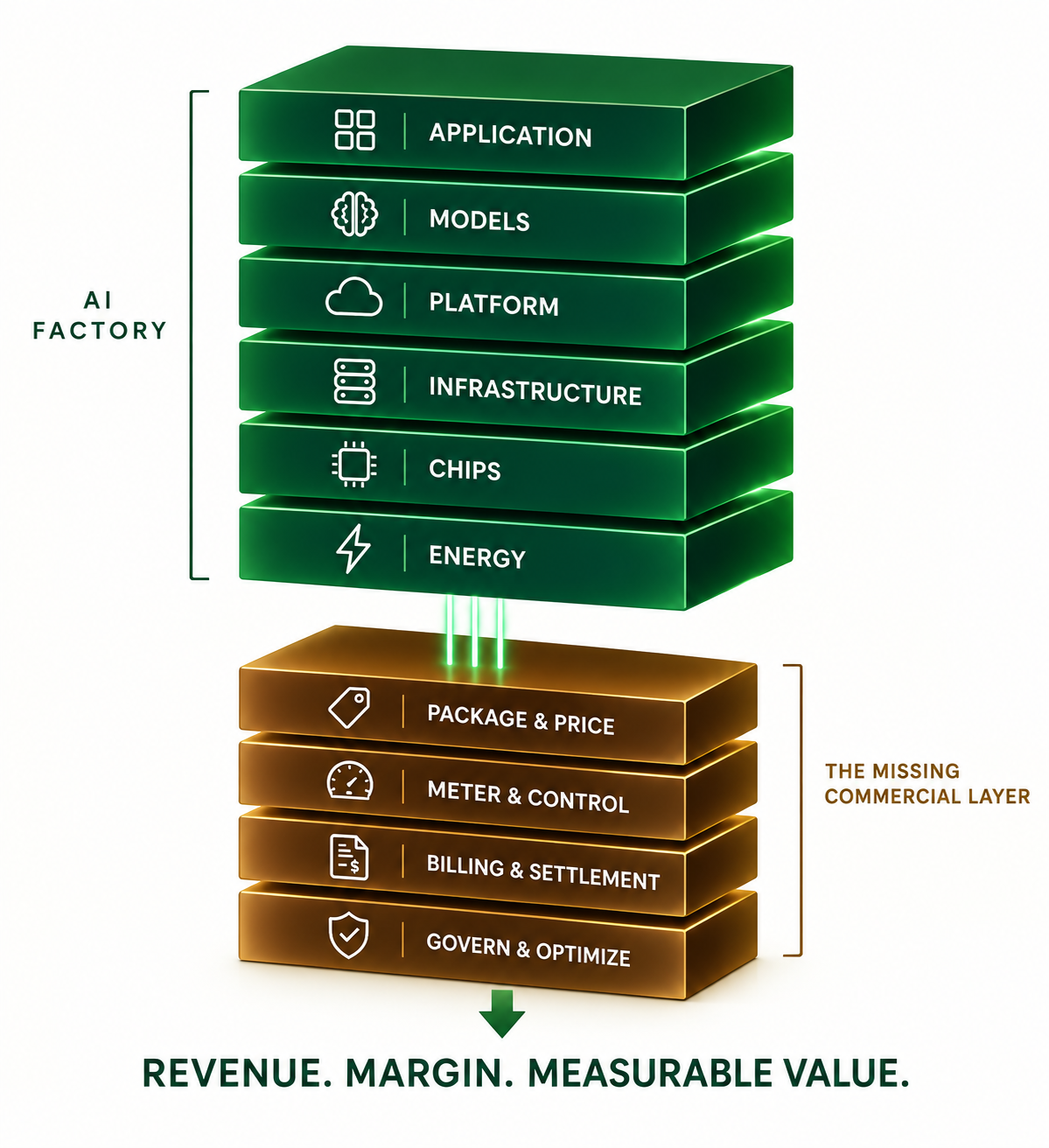
That means connecting what the AI Factory produces to how it is packaged and priced, metered and controlled, billed and settled, governed and optimized. This is the role we see emerging for revenue infrastructure in the AI era: not another infrastructure layer competing with the AI stack, but a commercial layer around it.
Monetization as the commercial layer connecting the AI factory stack to revenue, margin and measurable value.
[Infrastructure delivers the service. Revenue infrastructure turns that service into a business. Those are different engineering problems. Building an AI Factory and building a viable AI services business on top of it are not the same thing. - Viroo Mirji, Chief Strategy Officer & SVP Partnerships
5. Simulate the economics before production.
AI infrastructure is tested before production for obvious reasons. Capacity is modeled. Architectures are simulated. Performance is evaluated. Configurations are tuned. Why should the commercial model receive less scrutiny?
Before customer traffic goes live, teams should be able to explore what happens to margin when the consumption mix changes, whether entitlement rules behave correctly when usage crosses a threshold, how a new pricing model performs against realistic consumption, and what happens when multiple partners participate in one service.
This is where environments such as NVIDIA DSX Air become particularly interesting to us. Monetize360 uses NVIDIA DSX Air to simulate AI Factory environments and evaluate monetization configurations before production, while its connector and integration architecture extends the commercial model across the broader AI Factory ecosystem.
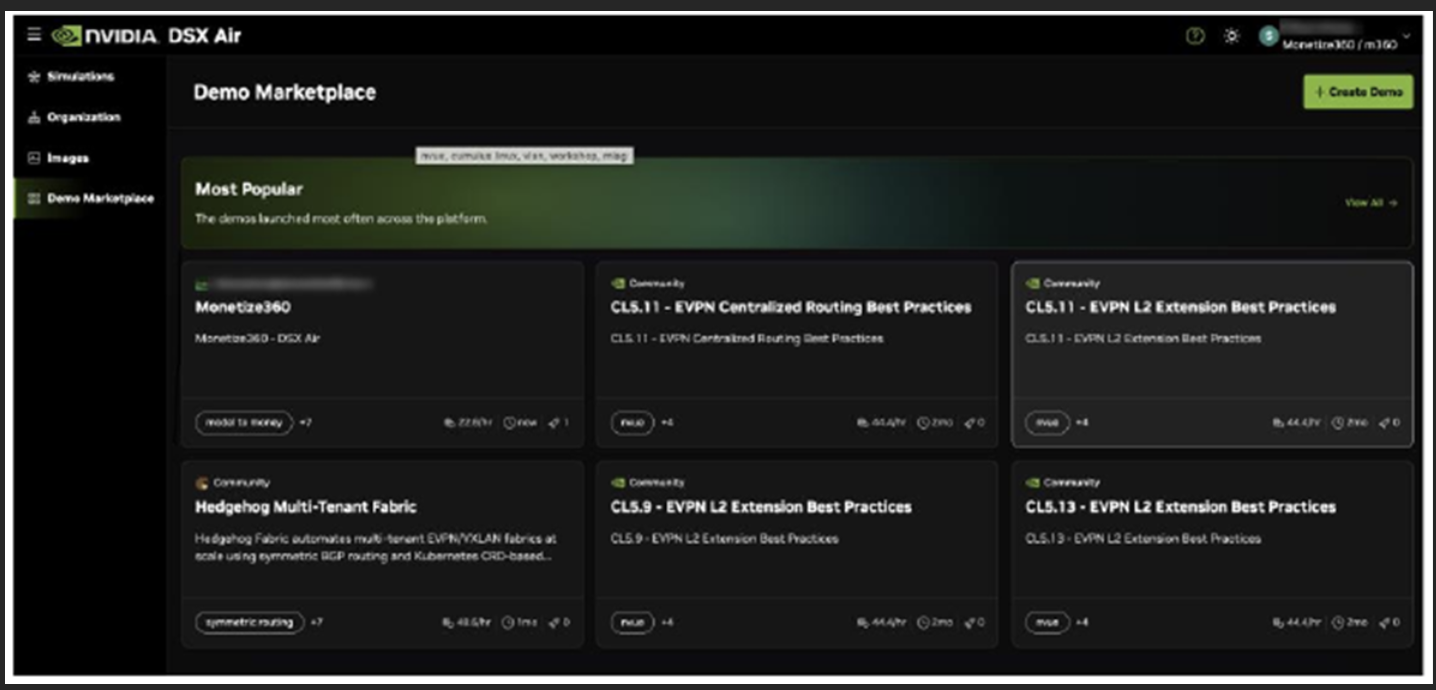
Don’t wait for the first invoice to discover whether the economics work.
Technical readiness and commercial readiness should increasingly be evaluated together.
6. Measure the business, not just the machine.
If Time-to-Revenue matters, what should an AI infrastructure provider actually measure? We do not think the answer is another dashboard containing fifty metrics. A small number of commercial measures can reveal a great deal.
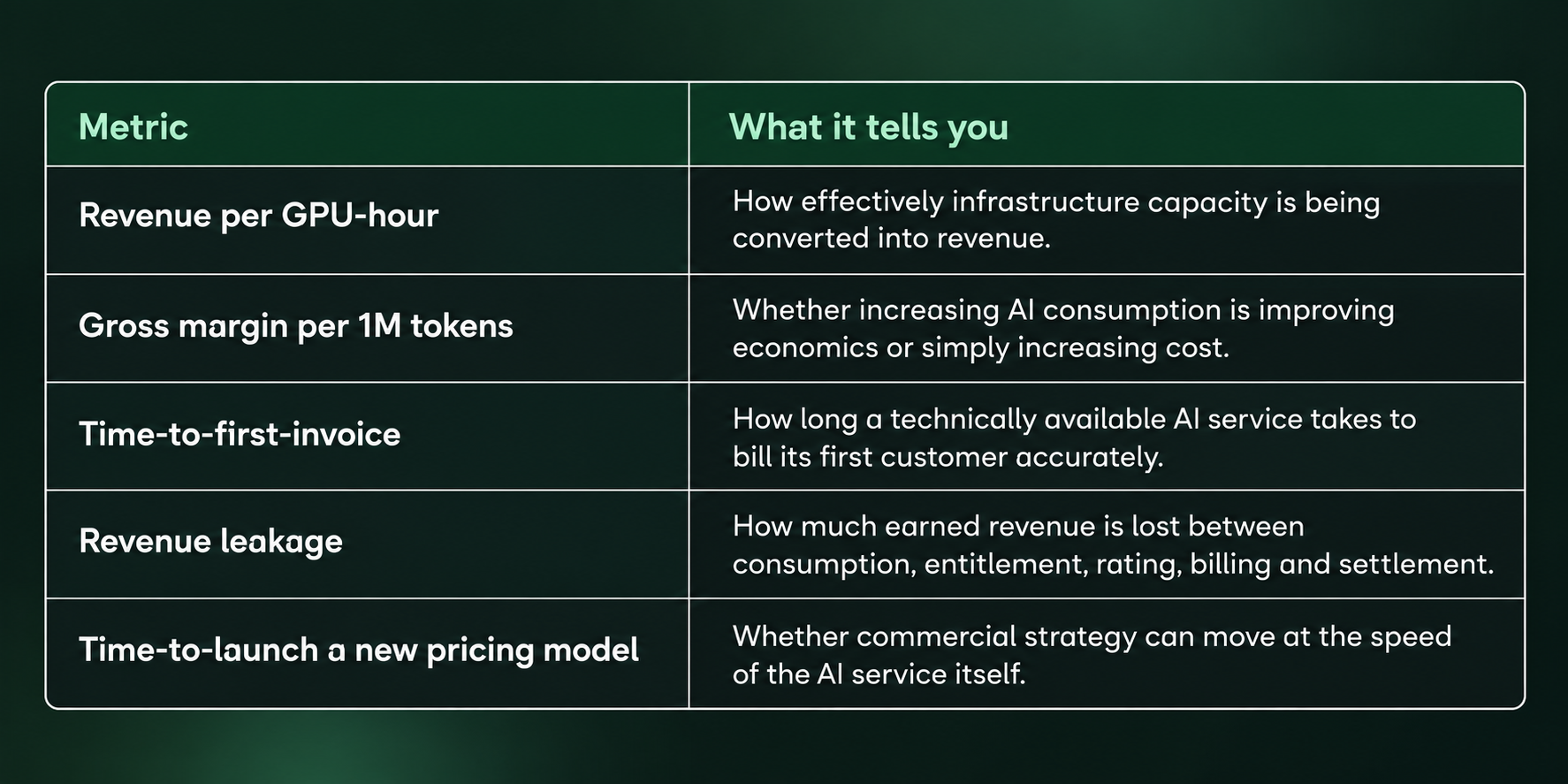
These metrics create an important bridge. Infrastructure tells you what the AI Factory produced and what it cost. Revenue infrastructure tells you what it earned, what it kept and how quickly.
That is the economic instrumentation the next phase of the AI Factory will require.
Optimize milliseconds. Shorten months.
Time-to-first-token has been an important measure of progress because latency matters. We should keep optimizing it.
But as AI factories become businesses rather than simply infrastructure projects, another measure deserves attention: how long does it take to move from the first token to the first accurate dollar of revenue?
Time-to-first-token tells us the infrastructure is working. Time-to-revenue tells us whether the commercial system around it is working.
The industry has done extraordinary work optimizing the milliseconds. Now we need to shorten the months too. Every week an AI service is technically live but not commercially ready delays its path to economic return. - Murali Saravu, Founder
The AI Factory has taught us how to manufacture intelligence at extraordinary scale. The next challenge is making that intelligence economically productive at the same speed.
Time-to-Revenue is the clock we think the AI industry should start watching.
Explore AI Factory monetization with Monetize360 →