.svg)


Neocloud Economics | Part 4 of 6
The infrastructure era of AI is hitting a harsh economic wall. GPU hoarding is no longer a moat; it is becoming a race to the bottom. As bare-metal compute turns into a commoditized utility, the operators who survive the decade will not be the ones with the largest clusters, but the ones who own the commercial architecture sitting on top of them.
Shifting from a raw hardware rental model to a high-margin managed AI platform requires a fundamental redesign of how revenue is captured, split, and scaled.
The margin reality of the stack
Chips are a low-margin commodity market vulnerable to rapid obsolescence and pricing pressure. As hardware supply catches up with demand, renting raw compute yields thinning returns. The margin story changes dramatically as you move up the stack:
- Inference workloads: Projected by ABI Research to account for 80 percent of the Neocloud market by 2030, inference carries software-level margins.
- Managed services: Outcome-based contracts and platform tooling are where the real P&L compounds.
- The four untapped streams: A chip-only billing model leaves four distinct revenue streams entirely on the table: AI models and applications, GPU capacity exchanges, managed services and tooling, and bundled solution tiers.
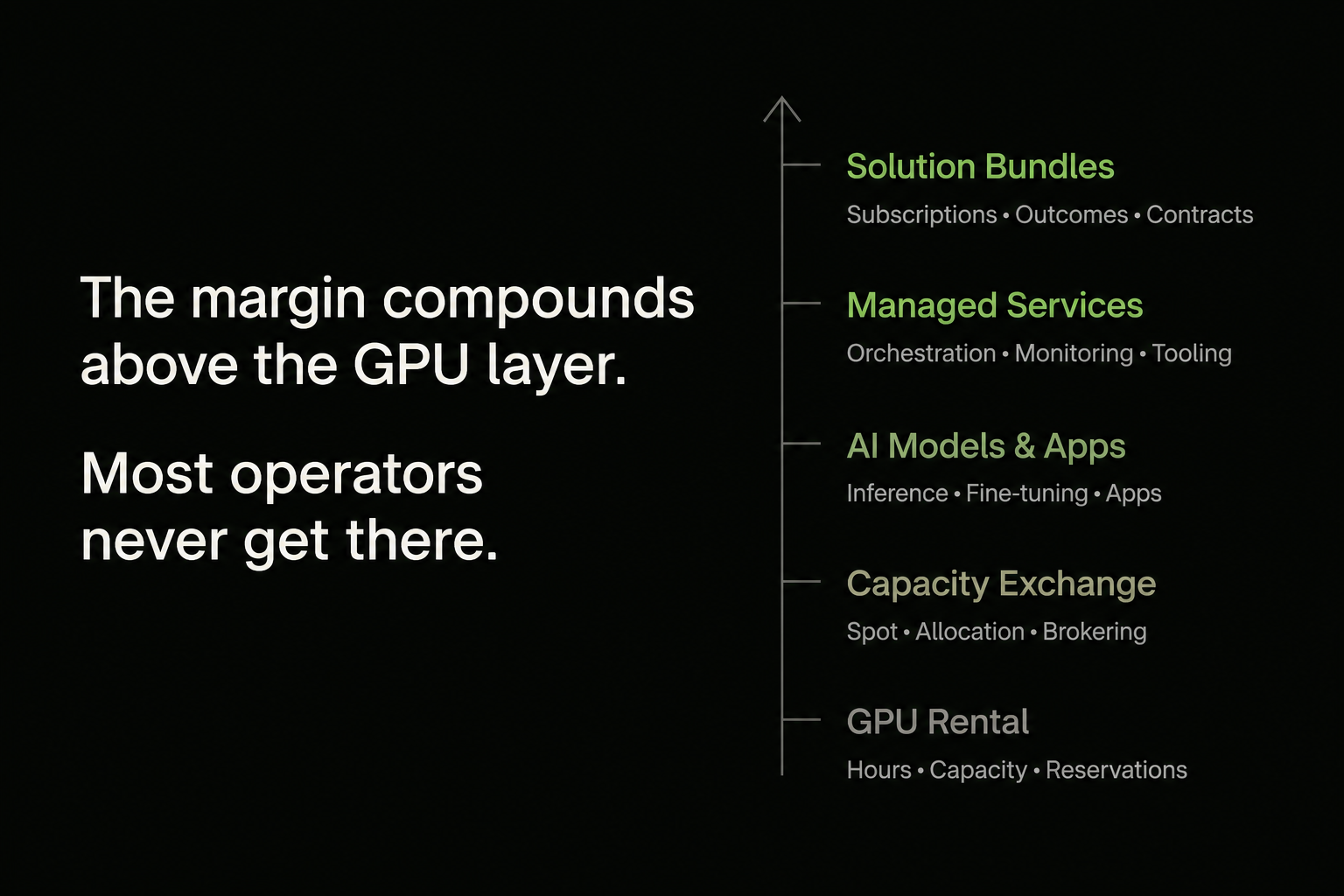
managed platforms and solution bundles.
Capturing this shift requires moving beyond static, one-size-fits-all pricing. Operators need distinct rate cards tailored by chip generation—pricing older architectures identically to Blackwell chips actively destroys margin. Furthermore, billing must transition from blunt hour-based tracking to orchestrator-native billing that fires dynamically at the job boundary. This ensures revenue is captured instantly as work is completed rather than reconciled manually from messy logs weeks later.
Engineering the marketplace engine
The ultimate expression of this economic evolution is an ecosystem marketplace where third-party partners can list fine-tuned models and specialized AI applications directly on your infrastructure.
However, running a marketplace without the underlying revenue architecture creates an operational nightmare. Advanced Neoclouds require single-operation atomic transactions: when a customer purchases a partner's model running on your hardware, the platform fee is captured, the partner margin is paid out, and the end-customer invoice is generated simultaneously, requiring zero human reconciliation.
Commercial models must evolve in lockstep with product innovation. If your billing infrastructure cannot support multi-layered monetization from day one, it will inevitably become the ceiling on your growth.
What challenges are you seeing in scaling your platform's revenue architecture beyond raw compute?
Up next: Why replacing your billing stack is the wrong answer, and what smart operators do instead. Part 5.
.png)
.svg)


.svg)


.svg)